You bought the wood round. Twelve inches, live edge, sanded so smooth it feels like a bad idea to burn anything into it. Then you dropped your favourite design onto it in the software and something was off. The artwork sat in the middle like a stamp on an envelope, or it ran off the sides, or it filled the width perfectly and left two bald crescents of empty wood at the top and bottom.
Nothing was wrong with the design. It was drawn for a rectangle, and you handed it a circle.
Tip
Short answer: a circle rewards subjects with a strong central mass and punishes long horizontal ones. A head portrait, a single bloom or a coiled animal fills a round naturally. A running wolf or a bass mid-strike either shrinks until it is lost or gets clipped by the rim.
The circle is a frame, and frames have opinions
A rectangle is forgiving. It has corners to park things in and a long axis that matches how most animals are shaped, so a design can be a bit loose and still look composed.
A circle has no corners and no long axis. Every direction from the centre is the same distance to the edge, which means the frame is constantly asking your subject to be as tall as it is wide. Subjects that agree look effortless. Subjects that disagree look like they are being squeezed, and no amount of scaling fixes it, because scaling changes size and the problem is shape.
This is the entire decision, and it is worth making before you pick a species or a flower rather than after.
Three subject shapes, three outcomes
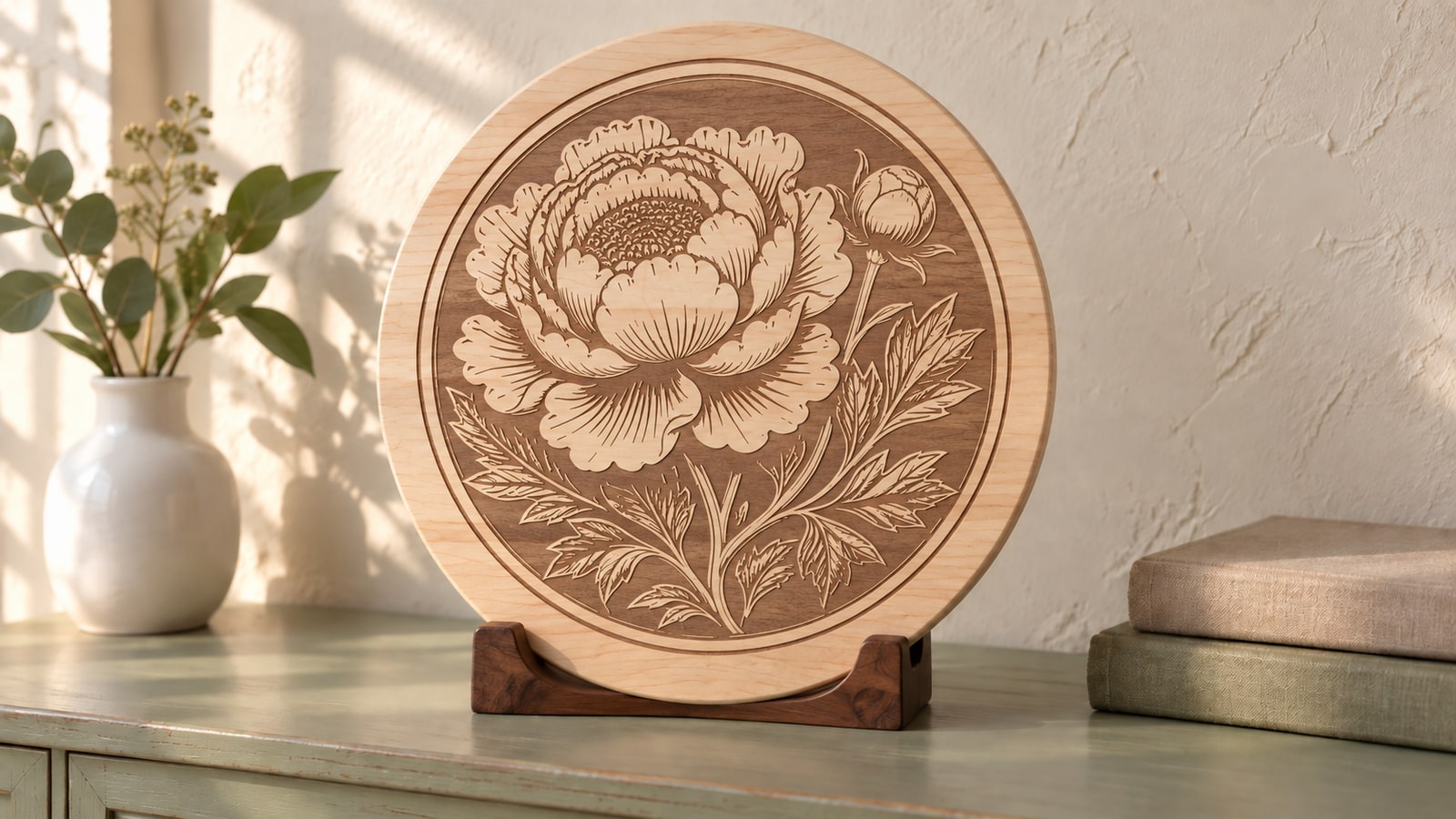
Central mass. A dog's head in three quarter view, a chrysanthemum, an owl facing forward, a compass rose. The visual weight sits in the middle and the outline is roughly circular already. These often fit naturally, with room to preserve an outer margin. Small-size performance still depends on their finest marks and gaps.
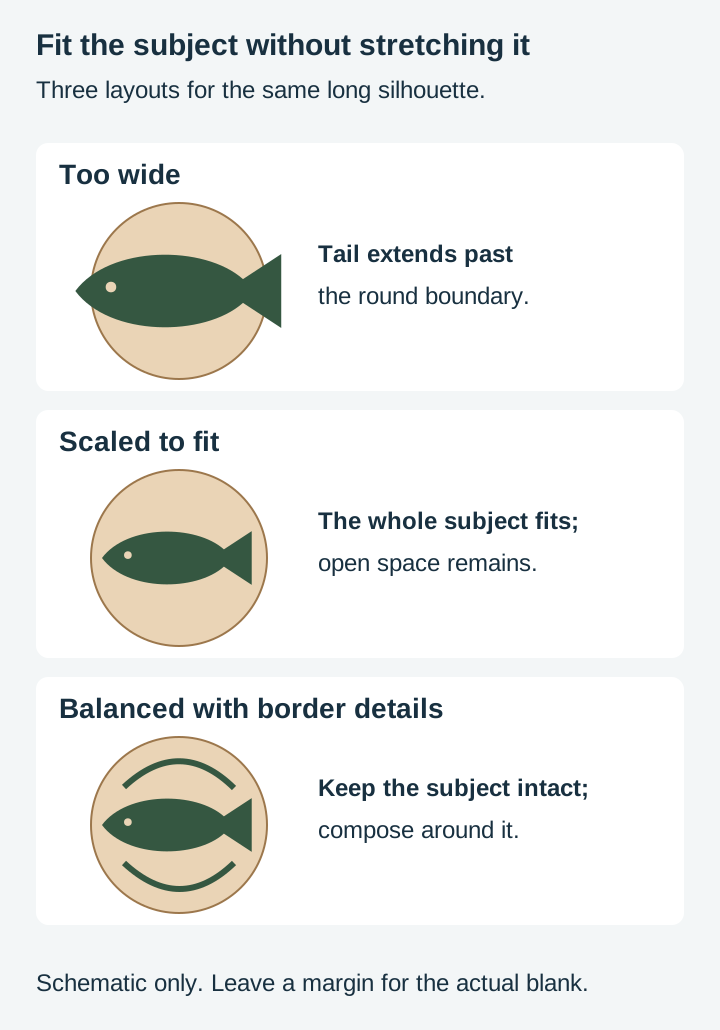
Long horizontal. A blue whale, a hammerhead shark, a leaping trout, a wolf mid stride. To fit the width of the circle the subject has to shrink, and once it does, the empty space migrates to the top and bottom of the frame where it reads as dead wood. The alternative is to scale it until the width fits edge to edge, at which point the rim slices off the tail and the nose. Neither is a good look on its own.
Tall or sparse. Foxglove spires, lily of the valley stems, a trailing clematis vine. These have the opposite problem. They fill the vertical axis and leave the left and right of the circle open, and because they are usually drawn as open line work rather than solid shapes, that emptiness is very visible.
None of these are bad subjects. They just need different handling, which is where the border comes in.
What a wreath ring is actually for
Look closely at the ocean medallions and you will see the pack quietly solving the horizontal problem in front of you. The clownfish sits in a full circular field because a clownfish among anemone tentacles is already a compact blob of a subject. The blue whale does not. It gets a narrower lens-shaped inner field, with kelp fronds, scallop shells and starfish packed into the crescents above and below it.
That ring is not decoration for its own sake. It is the design absorbing the space a long subject cannot fill, so the eye reads a full circle instead of a small whale marooned in a big empty one. Same trick on the hammerhead, the marlin and the sailfish.
Once you know to look for it, the ring tells you something useful about the file before you ever open it. A wreath can balance space around a long subject, but it can also be a stylistic choice. Judge the actual composition rather than inferring subject shape from the border alone.
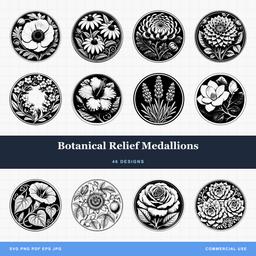 Botanical Relief Medallions46 designs, commercial license included$3.99
The botanical pack shows the same logic from the other direction. A single anemone bloom or a chrysanthemum reaches the rim on its own and needs nothing but a thin double line to close the edge. The lily of the valley and the clematis, which are sparse and vertical by nature, are drawn with far more open space and much lighter line work. They are beautiful on a big blank and they are the first designs to disappear on a small one.
Contrast decides how it reads from across the room
There is a second split running through these packs that matters more than most people expect, and it has nothing to do with shape.
Some medallions are drawn with a solid dark background behind the subject. Some are drawn as open line work on bare material. Both are correct, they just do different jobs.
The solid field designs, the boxer head, the bull terrier, the anemone, are essentially a light subject punched out of a dark disc. That is enormous contrast, so they hold together from ten feet away and they keep working when you shrink them. The open designs, the border collie lying in the grass, the clematis vine, are made of fine lines with material showing through everywhere. Up close they are the more sophisticated pieces. From the far side of a room they turn into a grey smudge on a wood round.
Match this to where the finished piece will hang. A sign above a workshop bench wants the high contrast version. A framed piece someone will stand in front of can be the delicate one.
Sizing, roughly
These are design-side starting points based on how we build the files, not measurements taken off a machine. Your material, your bit and your engraver's dot size will all move the line, so run a small test before committing a good blank.
| What to inspect | Why it matters | Adjustment |
|---|---|---|
| Finest hatch gap at final size | Close marks may merge | Enlarge or simplify detail |
| Space outside the artwork ring | Blank edges may be uneven | Preserve an intentional margin |
| Longest dimension of the subject | A circle can clip extremities | Fit proportionally; recompose surrounding art |
| Contrast at viewing distance | Fine linework can become indistinct | Test a bolder treatment or stronger material contrast |
The failure mode on a small blank is not that the design vanishes. It is that the fine hatching used to model the form merges into a solid dark mass, and the sculpted look you bought the file for flattens out.
Router or laser changes what you should pick
Worth being precise here, because the word relief gets used for two different things.
Our relief medallions are SVG line art. The three dimensional look is drawn, using directional hatching that follows the contours of the form and cast shadows that lift the subject off the background. A shallow laser engraving produces a largely flat marked face, and it still looks carved, because the illusion is in the drawing.
A CNC router can V-carve those same lines for genuine depth in the linework, which gives you real shadow that shifts as you walk past. What it will not do is sculpt the rounded, modelled surface you see in a true bas relief carving. That needs height data the SVG simply does not contain, which is what a depth map is for. If you are weighing up which of your machines can do what with these packs, the machine rundown covers it properly.
For a laser specifically, the contrast rule above matters twice over. A solid field design puts a lot of burn on the blank, which looks superb on light maple and can get muddy on a dark walnut where the background and the scorch converge.
Choosing by blank, not just by subject
Wood rounds with bark still on the edge already have a busy, irregular outer boundary. A medallion with a heavy decorative wreath fights that. The clean, ringless designs sit better there and let the bark be the frame.
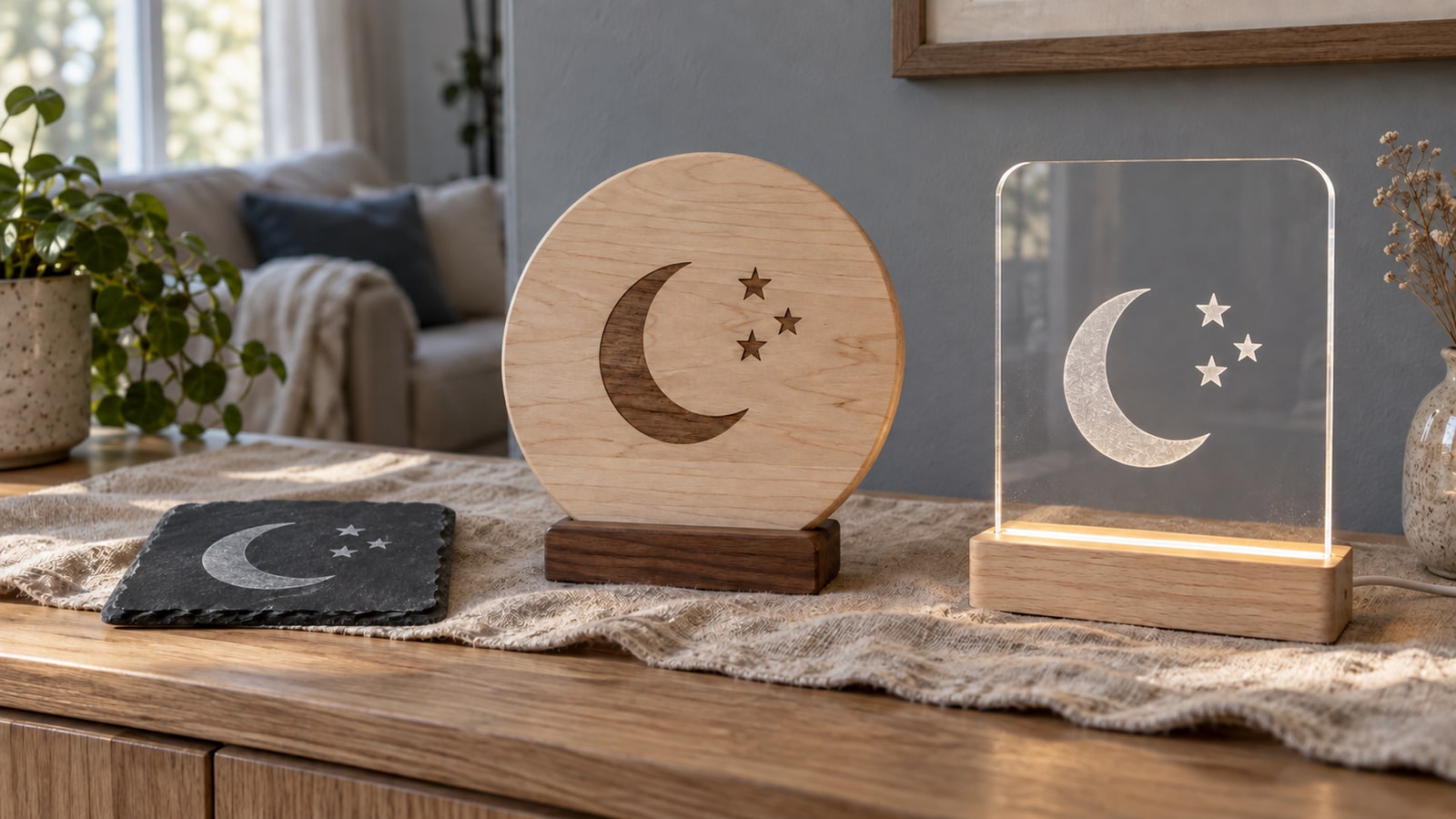
Slate coasters and slate rounds flip the tonal logic completely. Slate marks pale grey on a dark stone, so a design drawn as a light subject on a dark field arrives inverted and the whole image reads as a negative. Both open and filled designs can work on slate. Choose the intended positive or negative treatment, then verify the preview and a sample rather than assuming one style always works better. There is more on that in how to engrave on slate.
Acrylic rounds and pre-finished plywood circles are the easy case. They are flat, consistent and cut to a known diameter, which makes them the sensible place to try a design before you commit it to the expensive live edge slab.
Where to start
If someone has a dog, the breed portraits are close to a guaranteed gift, and the head studies in particular were drawn to fill a circle. For coastal and lake house pieces the ocean set covers both patterns, compact subjects for small rounds and wreath-framed ones for larger blanks.
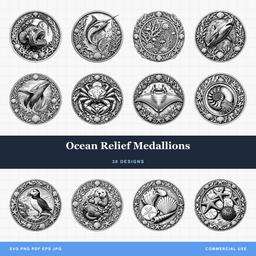 Ocean Relief Medallions30 designs, commercial license included$3.99
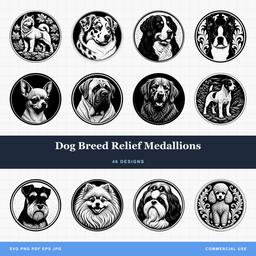 Dog Breed Relief Medallions46 designs, commercial license included$3.99
Every pack is $3.99, includes a commercial license, and ships as SVG, PNG, JPG, PDF and EPS, so the same medallion can go to your laser, your router, or a print-on-demand listing without buying anything twice. Browse the full set in Wildlife, Dogs and Sea Life, and pick the one whose subject already agrees with the circle.
Designs for this project
Frequently Asked Questions
What kind of design suits a round wood blank?
A subject with a strong central mass. Head portraits, single blooms, coiled animals and compass-style arrangements all read well because their weight sits in the middle and their outline is roughly as tall as it is wide. Long horizontal subjects like a running animal or a leaping fish need either a border that absorbs the leftover space above and below, or a much larger blank.
Do relief medallion files carve real 3D depth?
Not on their own. Our relief medallions are SVG line art that draws the light and shadow of a carved surface using hatching, so a laser burns them flat and the eye reads them as sculpted. Physical carved depth needs a depth map or a 3D model, which is a different kind of file entirely.
How small can a relief medallion go before it stops working?
The bold portrait designs with a solid dark background hold up on small blanks because their contrast survives even when fine hatching starts to merge. Open outline designs with no filled field, such as sparse stems or trailing vines, lose their detail first and want a bigger round.