Most sea life sells because it is pleasant. Turtles, dolphins, a tasteful anchor. It goes on a wall in a beach rental and nobody has strong feelings about it.
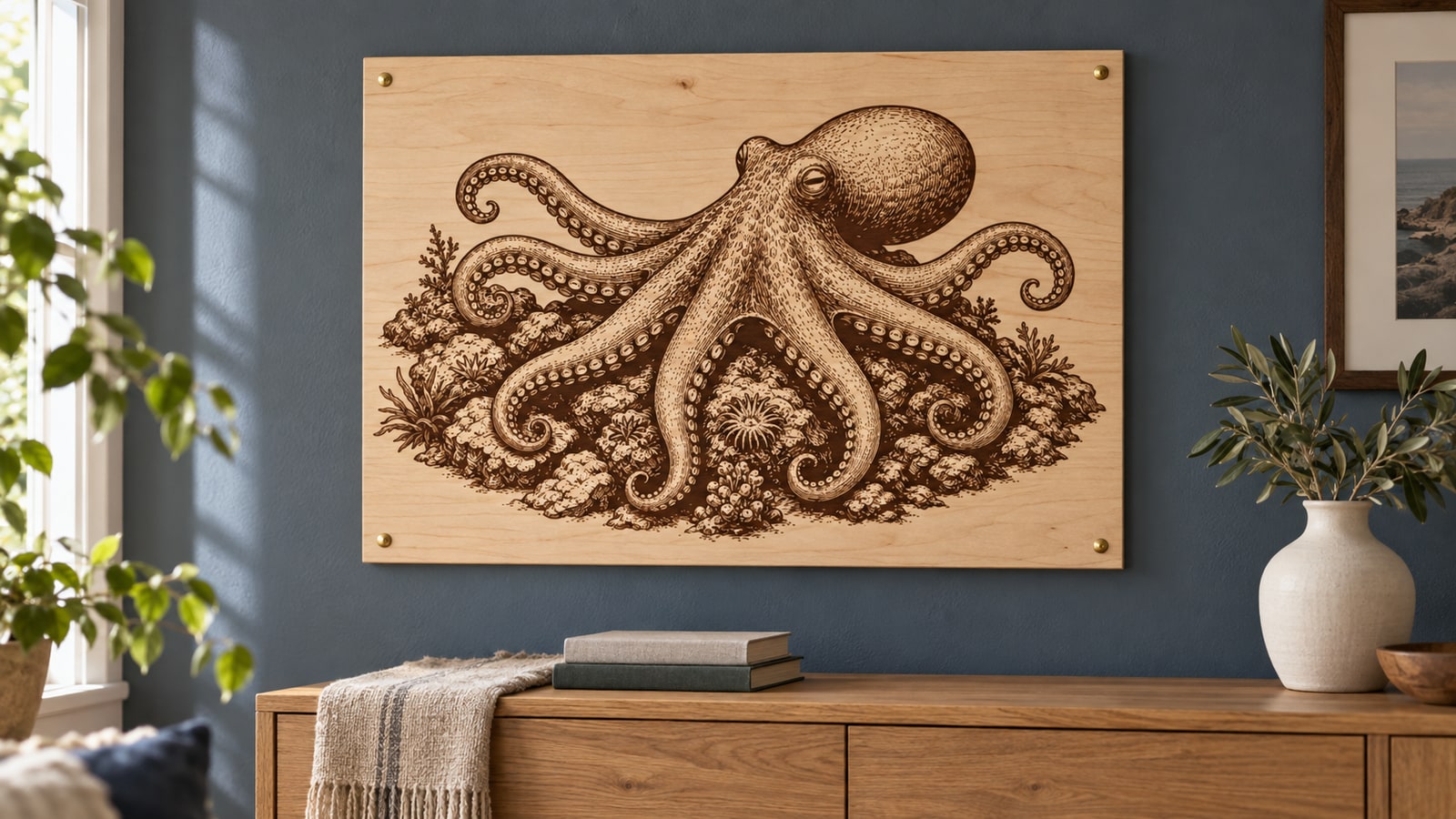
Then there is the other half of the ocean. An octopus with its arms curling out across two feet of walnut is not pleasant, it is a statement, and it sells to somebody who wants their hallway to be interesting. Those pieces command real prices.
They are also, without much competition, the hardest things in the catalogue to cut.
Tip
Short answer: deep sea subjects are statement pieces because their forms are complex, and they are difficult for exactly the same reason. Octopus arms, jellyfish tendrils, and coral branches are all long tapering shapes that end in almost nothing. Engrave them large and they are spectacular. At small sizes, delicate cut features need careful redesign and testing.
Why this group is its own problem
Our coastal and sea life post covers the friendly end: turtles, whales, nautical motifs, the things that go on a beach house sign. Those subjects have compact, closed silhouettes. A turtle is a shell with four flippers and a head, and every part of it is comfortably wide.
The deep sea group is built the opposite way. Octopus, squid, jellyfish, coral, anemones, and seahorses all share one structural trait: most of their visual mass is in thin, tapering, branching extensions off a small central body.
That is a drawing problem before it is a cutting problem. On the drawing side it means deciding where a tapering arm stops tapering, because in nature it goes to a point and in a cut file a very fine point can become fragile at the intended size. That decision is the actual craft in this category, and it is the difference between a file that produces the piece in the photo and one that produces a pile of broken tips.
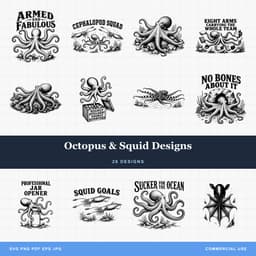 Octopus & Squid Designs28 designs, commercial license included$3.99
Octopus and squid
The showpiece of the group, and the reason people come looking.
What makes it work. The spiral. An octopus reads best when the arms flow in a single rotational direction rather than sticking out symmetrically, because the eye follows the curve around the piece. A radially symmetrical octopus looks like a diagram. A spiralling one looks alive.
The count matters. An octopus has eight arms. A squid has eight arms plus two longer tentacles, which is a genuinely different silhouette. Buyers in this category tend to be people who like cephalopods, and they notice. It is worth counting on any file before you cut it, including ours.
The trap. Suckers. A well-drawn octopus has visible suckers along the underside of the arms, and they are the detail that sells the piece up close. They are also dozens of small circles sitting on the narrowest part of the design. Engraved at size, they are gorgeous. Reduced to a keychain, they merge into a grey smear and the arm reads as textured mud.
Best treatments. Large engraved wall panels in walnut or dark hardwood. Layered wood pieces where the body sits proud of the arms. Modeled relief carving can also suit broad arm forms, but it requires a separately prepared height map or mesh, plus a tool-access check; these SVG packs supply line art.
Jellyfish
The most beautiful and the least cuttable subject in the catalogue.
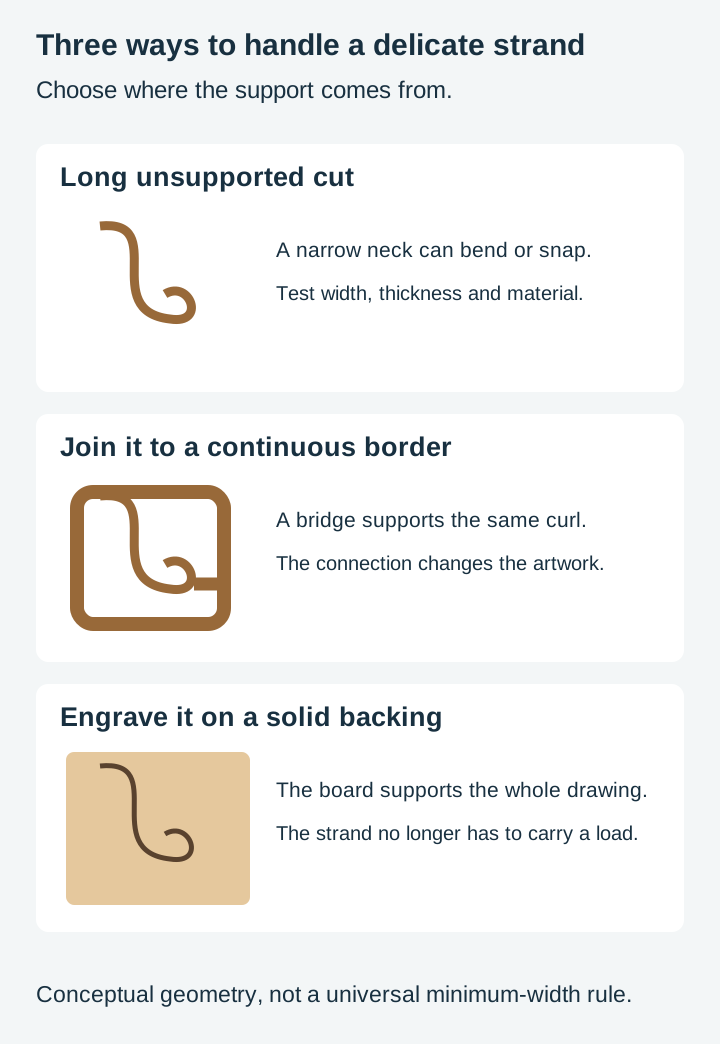
The jellyfish people want to make is a translucent bell with long trailing tendrils, and both halves are hostile to a blade. Translucency has no outline to cut. Tendrils are unsupported strands with no width to spare.
So a good jellyfish file makes a decision, and you should be able to see which one it made:
- Engraved detail inside a solid bell. The outer silhouette is the bell plus a suggestion of tendrils, and everything delicate lives as engraving inside it. This is the version that works on wood.
- Tendrils joined into ribbons. The strands are drawn wide and connected to each other so they form a lacework rather than loose threads. This is the version that can actually be cut.
- Deliberately open lacework. Evaluate the narrowest connections, material thickness and grain direction. Add a backing or simplify the drawing when those features cannot survive handling.
Jellyfish also do something none of the others do: they look correct hanging. A suspended adult display can work when every cut element has a deliberate physical connection and suitable hanging hardware. Delicate line art can also be engraved on one solid transparent panel.
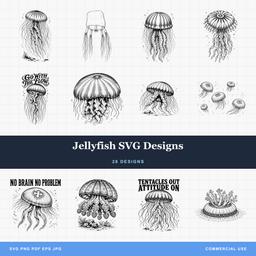 Jellyfish SVG Designs28 designs, commercial license included$3.99
Coral and anemones
The quiet workhorse of the group, and the one most people overlook.
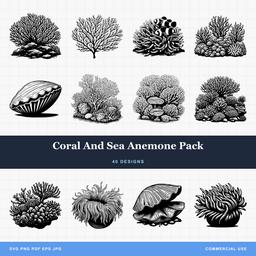
Coral offers branching and folded forms that can be stylized while preserving recognizable structure. Broad branches can make a design easier to cut, though their junctions and narrowest tips still need a material test.
Where it earns its place. As a border or a base. A coral band along the bottom of a sign, framing a fish or a diver silhouette, does more for a piece than another animal would. It is also the natural filler in a layered scene, giving you a middle depth between background and subject.
Anemones are the same idea with radial symmetry, which makes them excellent for round blanks: coasters, medallions, clock faces.
Seahorses
The easy one, and worth knowing why.
A seahorse is a single compact curl. The whole animal is one continuous shape with a strong recognisable profile, no separate limbs, and no thin extensions except the tail tip and the dorsal fin. That can make a suitably drawn seahorse easier to adapt for small cuts, although the tail, snout and fin still need enough width.
If you want deep sea character on a keychain, an earring, a small tag, or a vinyl decal, consider a bold seahorse and test the narrowest features. Use the octopus for the wall piece and the seahorse for the things that pay for the wall piece.
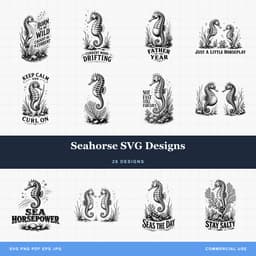 Seahorse SVG Designs28 designs, commercial license included$3.99
Matching subject to job
The table below is a design-side starting point drawn from how we build these files rather than results measured on machines we own. Test a small piece on your own material before committing to a large panel.
| Subject | Best at | Avoid | Why |
|---|---|---|---|
| Octopus, large engraved | Wall panels, cutting boards, box lids | Shrinking without a detail test | Arm tips and suckers need physical room |
| Octopus, bold silhouette | Vinyl decals, tumblers | Fine sucker detail | Simplified arms cut and weed cleanly |
| Squid | Tall narrow pieces, bookmarks | Wide square blanks | The long tentacles suit a vertical format |
| Jellyfish, engraved | Panels, slate, layered scenes | Cutting the tendrils | Strands have no width to spare |
| Jellyfish, cut lacework | Large rigid pieces, hanging mobiles | Fragile unsupported strands | Check material and connection widths |
| Coral and anemones | Borders, round blanks, layer fill | Being the only subject | Structure reads better supporting something |
| Seahorse | Keychains, charms, decals, earrings | Overly fine tail or fin tips | Even compact forms need a final-size test |
The pattern across the whole group: the more spectacular the subject, the larger it needs to be. That is not a limitation so much as a pricing opportunity, since large pieces are where the margin lives.
Materials that suit the depths
Dark hardwood is the natural home. Walnut can give a subdued dark mark. If you want pale artwork on a dark board, use a deliberate compatible paint-fill or inlay process; do not assume ordinary laser engraving turns walnut white. Pale maple with dark engraving is another clear option.
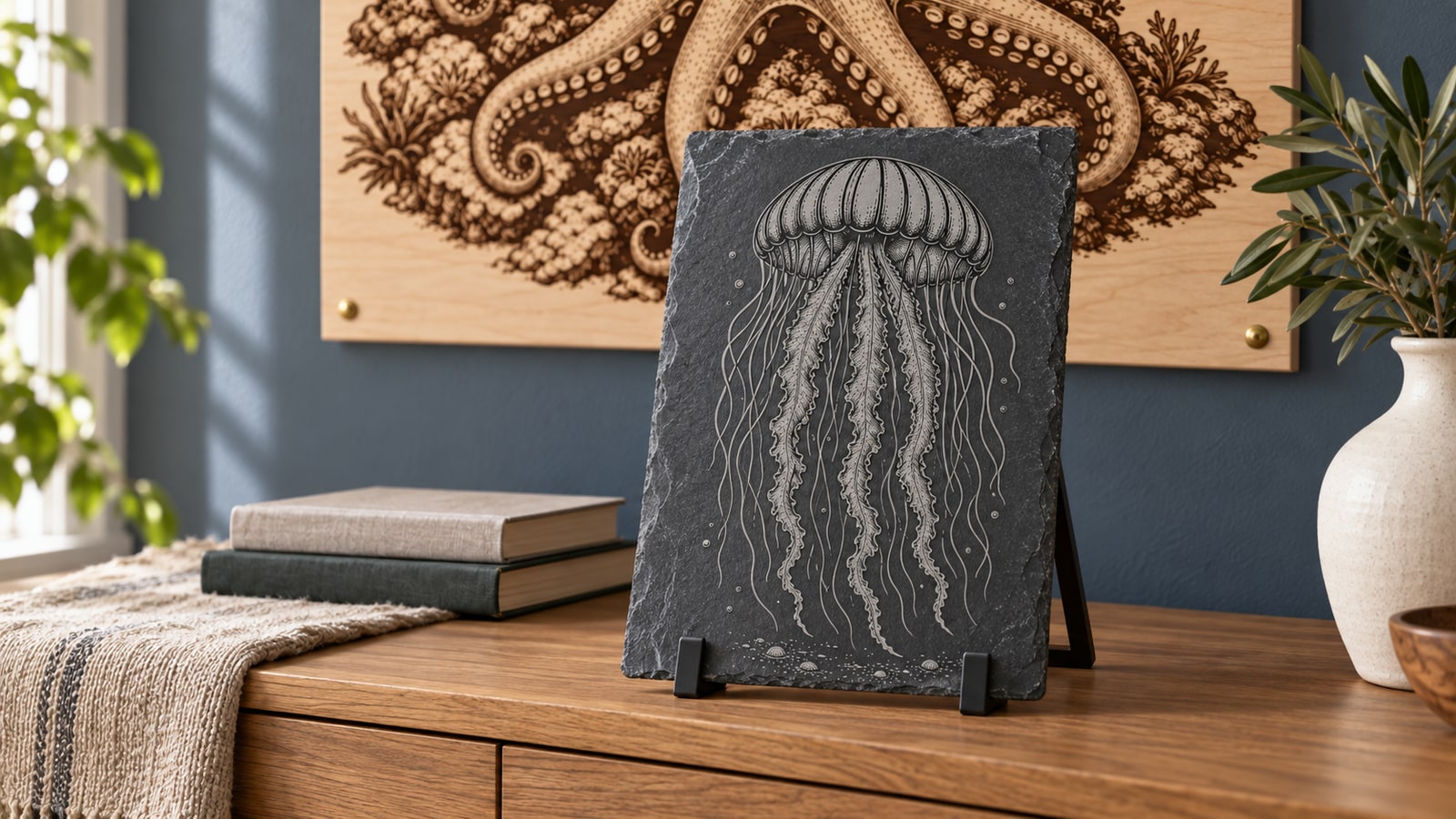
Slate does something specific and worth knowing: a laser mark on slate comes out pale grey against the dark face, so a jellyfish engraved on slate reads as a luminous shape floating in dark water. That is the single best material match in this whole category, and our slate engraving guide covers the specifics.
Layered wood suits the group better than most subjects, because these animals genuinely have depth. Arms in front of a body, tendrils behind a bell.
Acrylic, especially frosted or coloured, is the one place a translucent subject can be rendered honestly.
Selling statement pieces
Two things about this category commercially.
Price them as art, not as craft. A two-foot engraved octopus panel is not competing with keychains. It is competing with what someone would otherwise hang on that wall, and that is a much higher number. Our pricing post covers the reasoning.
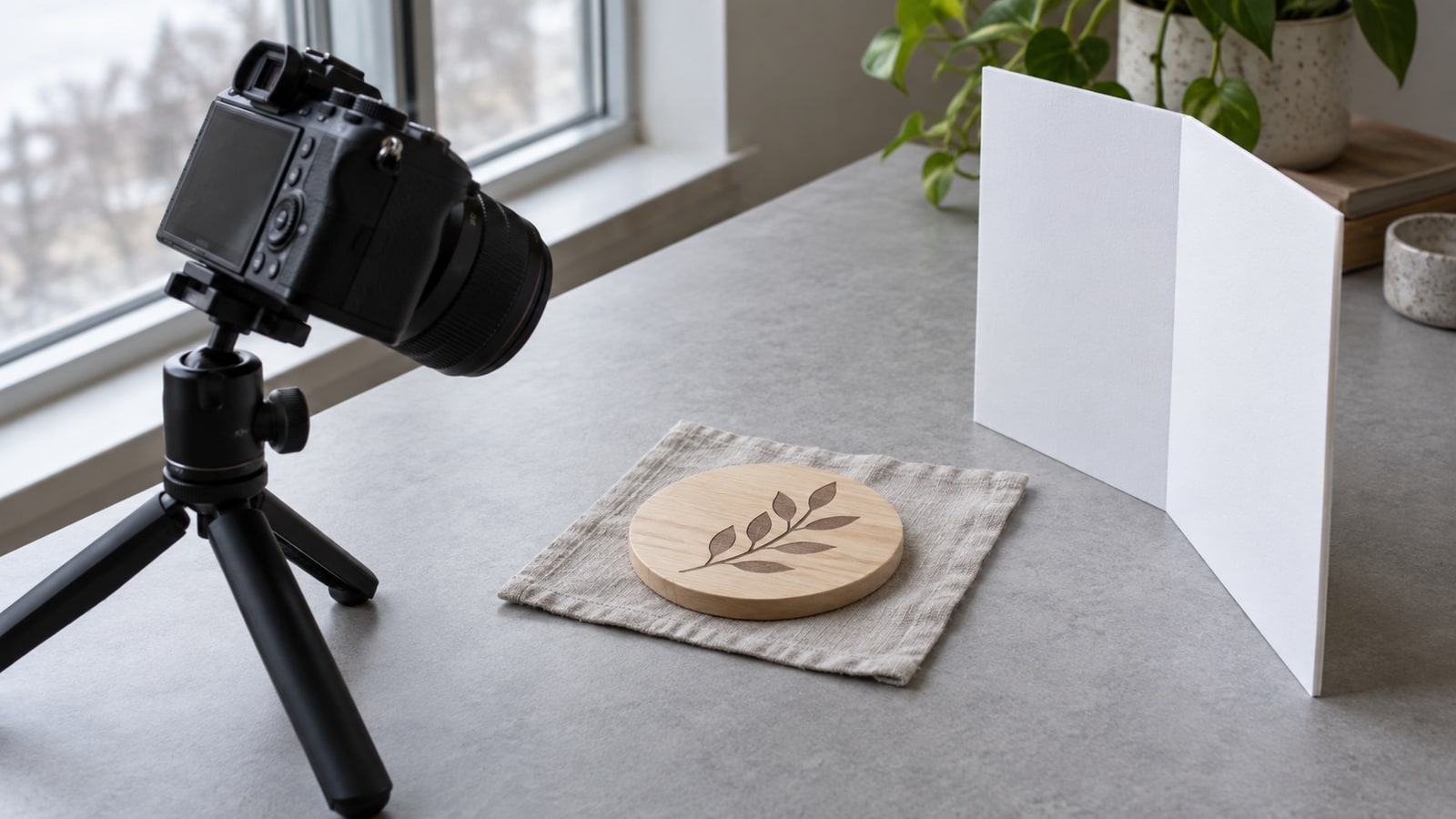
Photograph them in a room. These pieces sell on presence, and presence does not survive a white background. On a wall, with furniture in frame for scale, is the shot.
And pair the big piece with the small one. A customer who cannot justify the panel will often buy the seahorse keychain, and they are the same visual family.
Where to start
If you have never cut this group, start with coral or a seahorse and get a feel for how the forms behave in your material. Then go large with the octopus, because that is the one people photograph.
Every pack is $3.99 and ships as SVG, PNG, JPG, PDF, and EPS, so the same design covers your engraving, your vinyl, and your sublimation work. The commercial license is included with every purchase with no cap on physical sales, and print-on-demand is allowed, which is unusual in this market.
Browse the sea life collection for the rest of the depths.
Designs for this project
Frequently Asked Questions
Why are octopus designs so hard to cut?
The arms. Eight of them, each tapering from thick at the body to almost nothing at the tip, usually curling and crossing each other. Every tip is the thinnest part of the design and the first thing to snap, tear, or lift, and a design with eight of them has eight chances to fail.
Can a jellyfish design be cut rather than engraved?
Only if it was drawn for it. A jellyfish is mostly trailing tendrils, which as cut shapes are long unsupported strands. A cut-ready jellyfish either thickens those strands, joins them to each other, or accepts them as engraved detail inside a solid bell.
What size should a statement octopus piece be?
Larger than you think. These designs earn their keep by being the thing people notice from across a room, and the fine arm detail needs physical room to survive. If you are working small, use a compact curled pose rather than a sprawling one.
Do deep sea designs work in vinyl?
Coral and simple octopus silhouettes do. Jellyfish and anything with long trailing detail generally do not, because the tendrils become slivers that fight you during weeding. Pick the bold-form subjects for vinyl and save the delicate ones for engraving.