Every beginner asks which material to start on, and gets three confident and contradictory answers.
The reason the answers conflict is that the question hides a second one. What process, finish and use does the project need? Those questions are more useful than choosing a material by its name alone.
Tip
Short answer: choose a board approved for your process first. Plywood offers a wood face and cross-laminated structure, solid wood offers natural grain with directional constraints, and MDF offers a uniform fiber surface useful for painted work. Check the actual grade and thickness before cutting.
They are three genuinely different materials
Worth being precise about, because the differences are structural rather than cosmetic and they change how a design behaves.
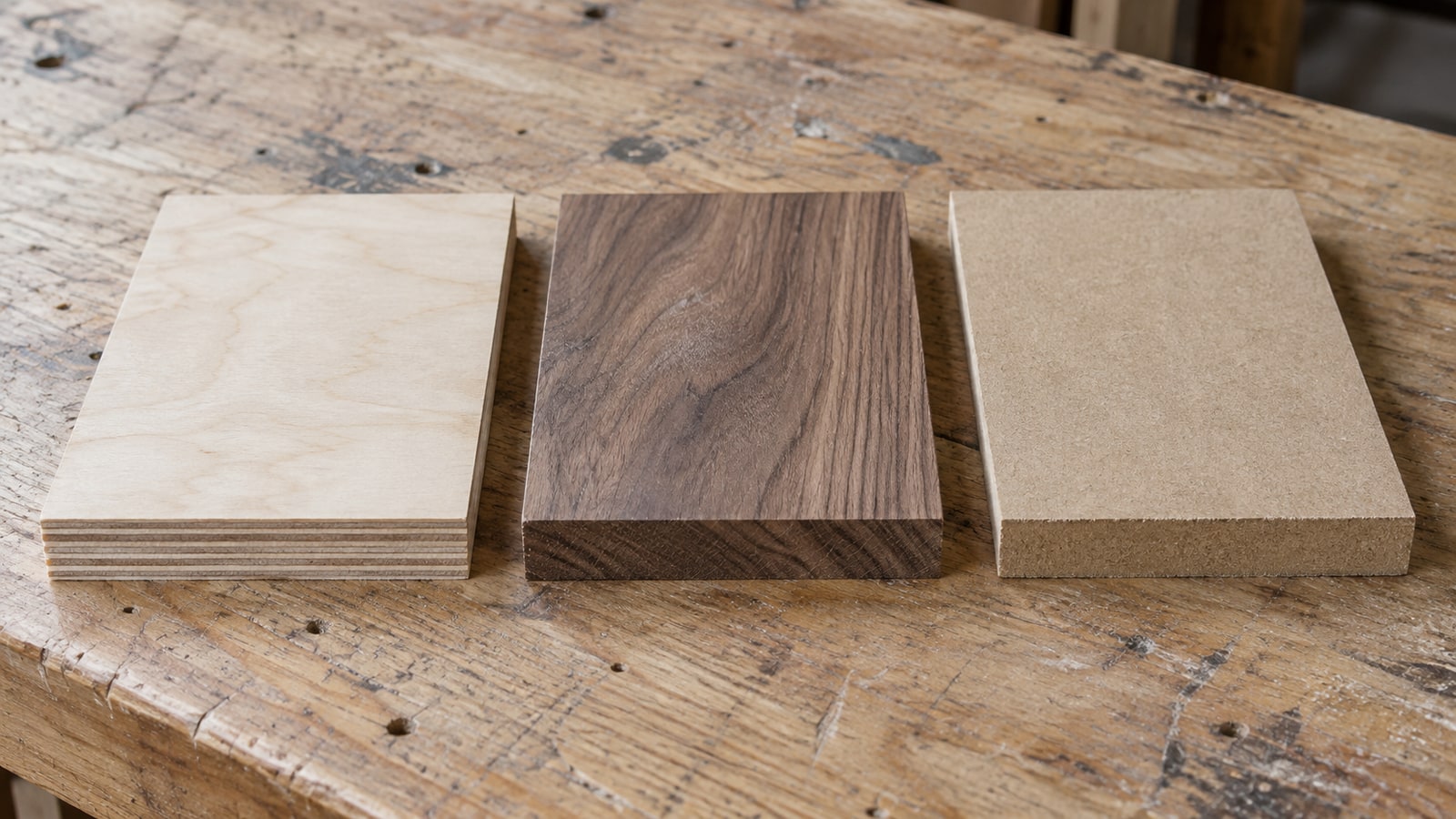
Solid wood is a single piece of a tree. It has continuous grain running in one direction, it varies between species and between boards, it moves with humidity, and it is stronger along the grain than across it. Every one of those facts has a design consequence.
Plywood is thin veneers glued in alternating directions. That cross-lamination is the whole point: it reduces directional differences and moisture movement compared with solid wood. Plywood can still have a stronger axis and can still warp or change dimension. The trade is that you now have glue lines through the material and, depending on grade, internal voids where a veneer layer has a gap in it.
MDF is wood fibre and resin compressed into a board. It has no directional wood grain, but density, thickness and moisture can vary. Its relatively uniform surface is useful for many painted projects. It is also heavier than it looks and it does not like moisture at all.
That is the real comparison. Everything else follows from it.
What each one does to your design
This is the part we can speak to properly, because it is about how a file behaves rather than how a machine is set up.
Grain direction is a design constraint in solid wood
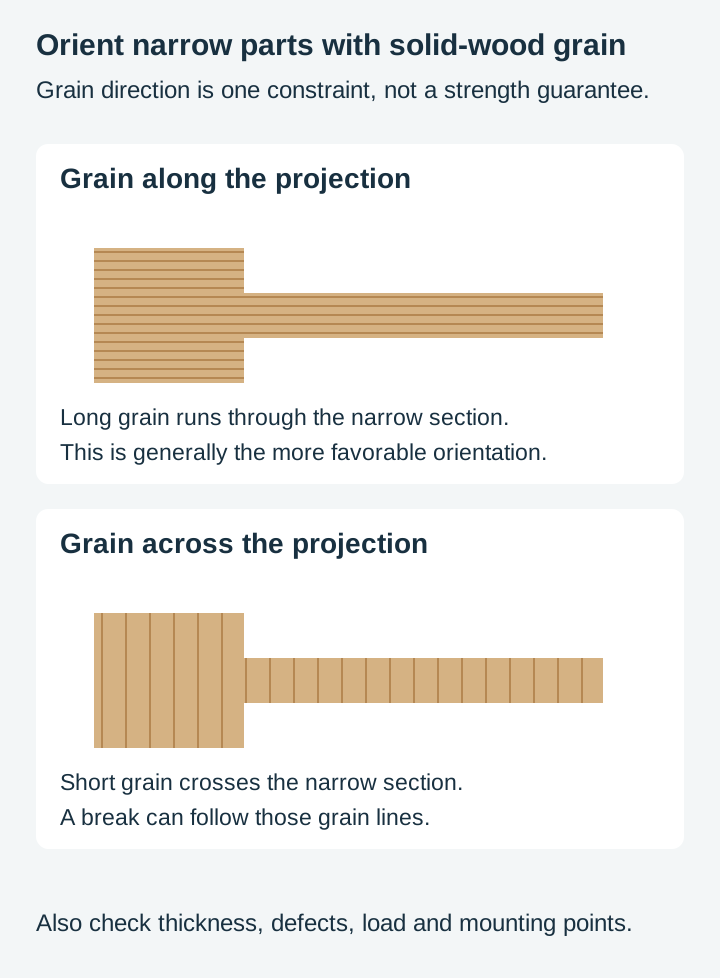
If a design has a thin projecting part, a leg, an antler, a letter stem, a tail, then in solid wood the direction of the grain relative to that part decides whether it survives.
Grain running along the length of a thin part supports it. Grain running across it creates a line the piece wants to break along, which can make it vulnerable during handling.
This means orientation on the board is part of the job in solid wood, and it can genuinely dictate how you nest parts. Cross-lamination reduces the problem in plywood rather than removing it: a sheet still has a face grain direction and a stronger axis, it is simply far less lopsided than a solid board. MDF has no grain direction at all. That is a real reason to reach for sheet goods for anything delicate, and it is worth weighing against how much nicer solid wood looks.
Our post on detail and small items covers the general version of the thin-part problem.
Edges are visible, and they look different
On a cut-through design the edge is a surface you are showing whether you meant to or not.
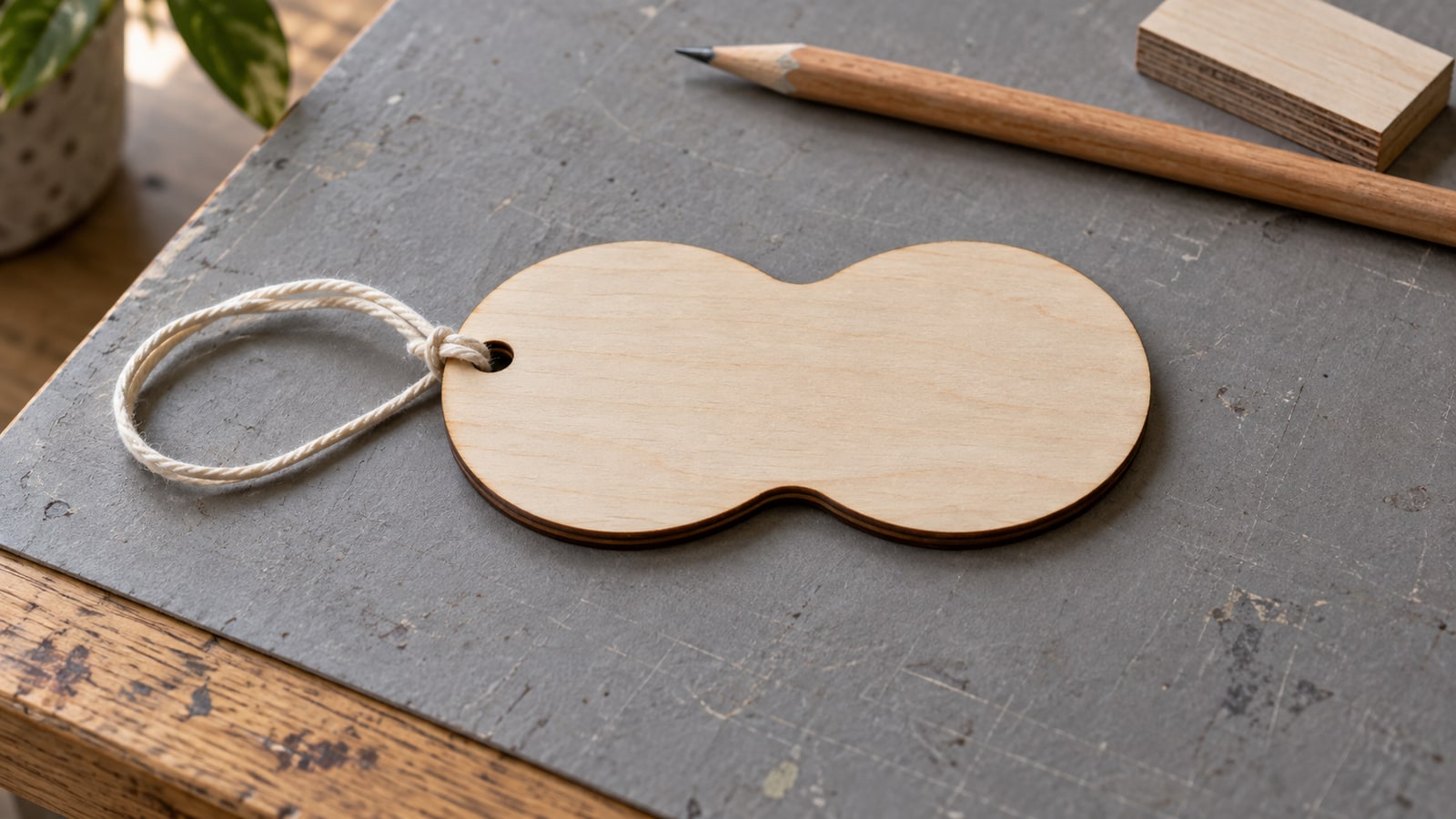
Plywood shows its layers as fine stripes along every cut edge. Some people love this and design around it. Some find it reads as cheap. It is not neutral either way, and on a piece with a lot of internal cut detail you will be seeing a lot of it.
Solid wood shows side grain or end grain according to which face you cut. The pattern should agree with the board’s actual grain direction.
MDF has a fine fibrous edge rather than veneer stripes or solid-wood grain. The edge can absorb finish differently from the face and usually needs preparation for a smooth painted result.
So a design with a lot of small cut-outs is a different proposition in each material, and it is worth deciding which edge you want before you choose the design rather than after.
Voids are a plywood-specific hazard
Cheaper plywood can contain gaps inside the layers where a veneer did not quite meet. You cannot see them from the face. You find them when a cut passes through one and the edge comes out ragged, or when a thin part snaps because there was nothing inside it.
Higher grade plywood is specified with fewer voids for exactly this reason, and it costs more for exactly this reason. For designs with a lot of fine internal detail that difference matters more than for a plain sign, because a plain sign has fewer places for a void to ruin.
 Backyard BBQ Badges28 designs, commercial license included$3.99
The honest comparison
The notes below are a design-side starting point drawn from how we build files and what the materials are, not from measurements taken on machines we own. Suppliers publish their own guidance for their specific products, and that is the right source for anything about processing. Test on your own material before a batch.
| Solid wood | Plywood | MDF | |
|---|---|---|---|
| Consistency | Varies by species and board | Varies by grade and sheet | Very consistent |
| Grain | Continuous, directional | Cross-laminated, face grain visible | None |
| Design constraint | Grain direction on thin parts | Voids, veneer thickness, face direction | Thin sections, edge strength, moisture |
| Cut edge | Side grain or end grain | Visible layer stripes | Fine compressed fibers |
| Takes paint | Species and preparation matter | Face and edge need different preparation | Smooth face; seal and prepare edges |
| Takes stain | Species and preparation matter | Thin face veneer limits sanding | Conventional stain rarely resembles solid wood |
| Appearance | Natural grain and variation | Wood face with layered edges | Uniform fiber surface, often painted |
| Best for | Heirloom pieces, gifts, engraving | General cutting and signs | Painted work, prototypes, learning |
Appearance is one part of the choice. The intended finish, environment and structural demands matter alongside it.
Safety and supplier guidance
One area where general advice is genuinely dangerous, so this section is short and points elsewhere on purpose.
MDF produces a lot of very fine dust when machined, and its dust is a recognised respiratory concern. Some sheet goods contain adhesives that are not suitable for every process. Anything with a coating or a treatment can behave unpredictably.
Manufacturers and material suppliers publish safety data and processing guidance for their own products. That is the authority for extraction, for whether a given board is suitable for your machine at all, and for what protective equipment you need. We make design files and we own no machines, so we are not the right source for any of it, and neither is a general blog post.
The one habit worth stating plainly: know what the board is before you cut it. Unlabelled offcuts of unknown material are exactly where the unpleasant surprises come from.
What to actually start with
If you are learning, use a small piece of known, machine-compatible stock with supplier guidance for the intended process. MDF can be useful for CNC prototypes and compatible laser work, but it is not a universal first choice for every laser or thickness.
If you want a wood face in a sheet material, consider quality plywood. Compare veneer quality, adhesive, internal voids and finished-edge appearance, and choose stock specified for your machine.
If you want natural solid-wood grain, accept its directional and moisture constraints. Orient thin parts along the grain, expect variation between boards, and design pieces that are chunky enough not to be fighting the material.
If you are painting it, MDF can provide a smooth starting face. Prepare its absorbent edges with the appropriate sealer or primer; plywood and solid wood can also be painted successfully.
 Bathroom Humor Signs43 designs, commercial license included$3.99
The habit that matters more than the choice
Cut a test piece of the most demanding part of the design, on the actual sheet, at the actual size.
Sheet goods vary between suppliers and between batches from the same supplier. That is not pessimism, it is how the products are made. The piece that came out perfectly last month tells you very little about the sheet you just bought.
Our test cuts post covers doing that properly, and our burn marks post covers what the design itself contributes to how clean the result is.
Where to start
Choose small samples of two materials supported by your machine, then test the same design with settings appropriate to each. You will learn more in that hour than from any amount of reading, and you will have a direct comparison in your hand rather than an opinion.
Every design in our catalogue ships as SVG, PNG, JPG, PDF, and EPS so you can choose a suitable starting file, then inspect its geometry for the selected material and operation. Browse the full catalogue at $3.99 a pack, commercial license included with every purchase and no cap on how many physical products you sell.
Designs for this project
Frequently Asked Questions
Is MDF or plywood better for a beginner?
Start with material specifically supported by your machine and supplier. MDF has no directional wood grain and can be useful for painted prototypes; laser-suitable plywood is useful when you want a wood face. Grade, thickness, adhesive and moisture still matter. We do not have sales data showing that one material sells better.
Why does my plywood sometimes cut cleanly and sometimes not?
Because plywood is not one material. It is layers of veneer with glue between them, and the glue type, the number of plies, the void content, and the face veneer all vary between suppliers and even between sheets. That inconsistency is inherent to the product rather than something you are doing wrong.
Does grain direction matter in a design?
In solid wood it matters a great deal. A thin projecting part with the grain running across it is much weaker than the same part with grain running along it, and it will snap along the grain line. Cross-lamination greatly reduces that lopsidedness in plywood, though a sheet still has a face grain and a stronger axis, and MDF has no grain direction at all. That is one of the main reasons people reach for sheet goods for delicate work.
Which material takes paint best?
MDF has a smooth face without visible wood grain, which makes it useful for painted work. Its absorbent cut edges and fibers can still need sealing, priming and sanding. Solid wood and plywood can also take a smooth finish with preparation suited to the species and coating.