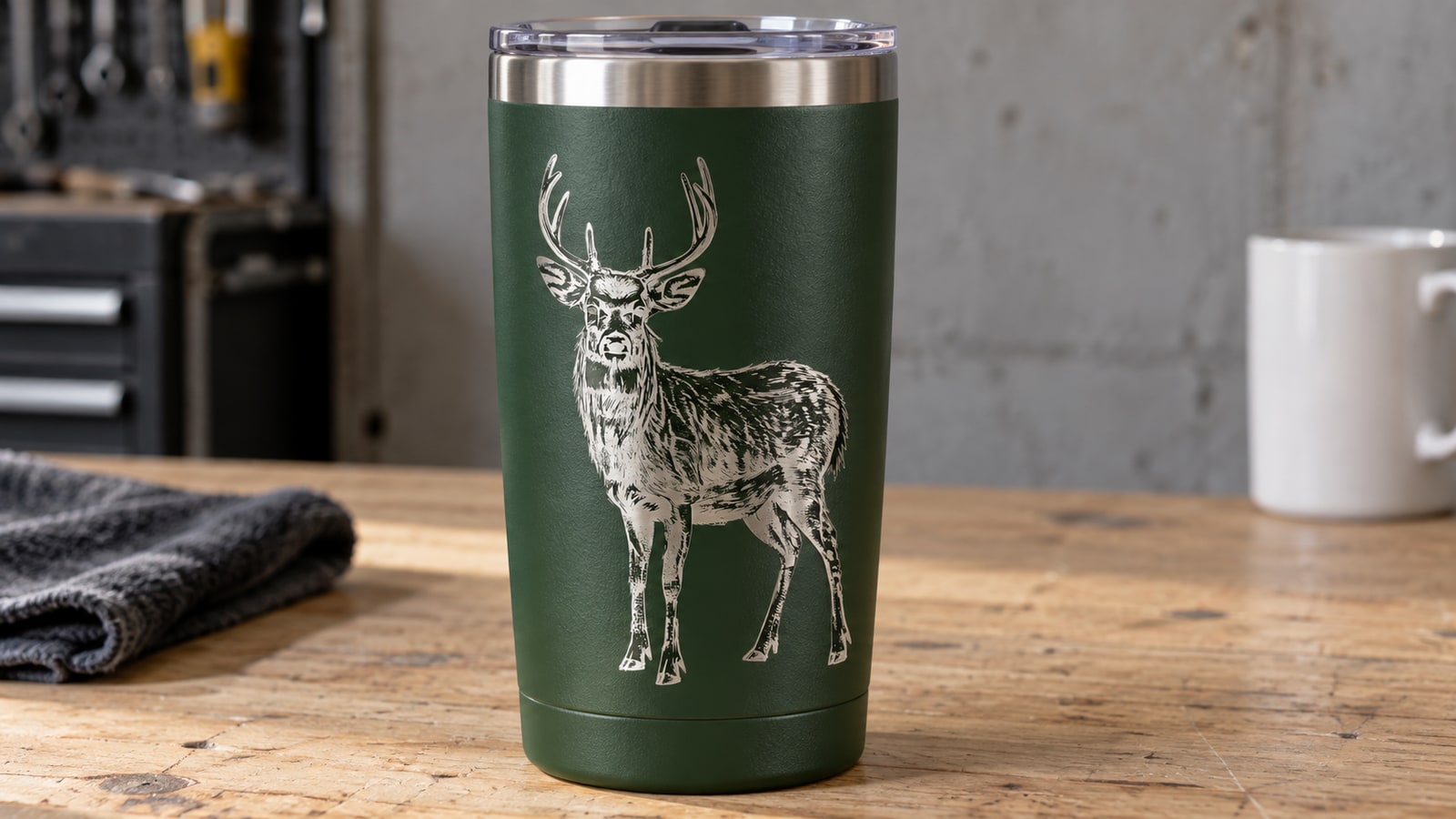
Two tumblers arrive in the same box. Same size, same lid, same photo on the listing. One goes under the laser and comes out with a crisp silver design against the colour. The other runs the identical job and comes out looking exactly like it did before, maybe with a faint smudge you can rub off with a thumb.
Different blanks can explain that result, even when they look similar. Focus, settings and laser compatibility also need checking; appearance alone does not diagnose the failure.
Tip
The short answer: on a coated blank the laser removes a layer of powder coat, lacquer, or dye, and the mark you see is whatever sits underneath. Bare-metal marking uses a different mechanism and depends on the metal and laser wavelength. Before you buy, work out which one you are holding.
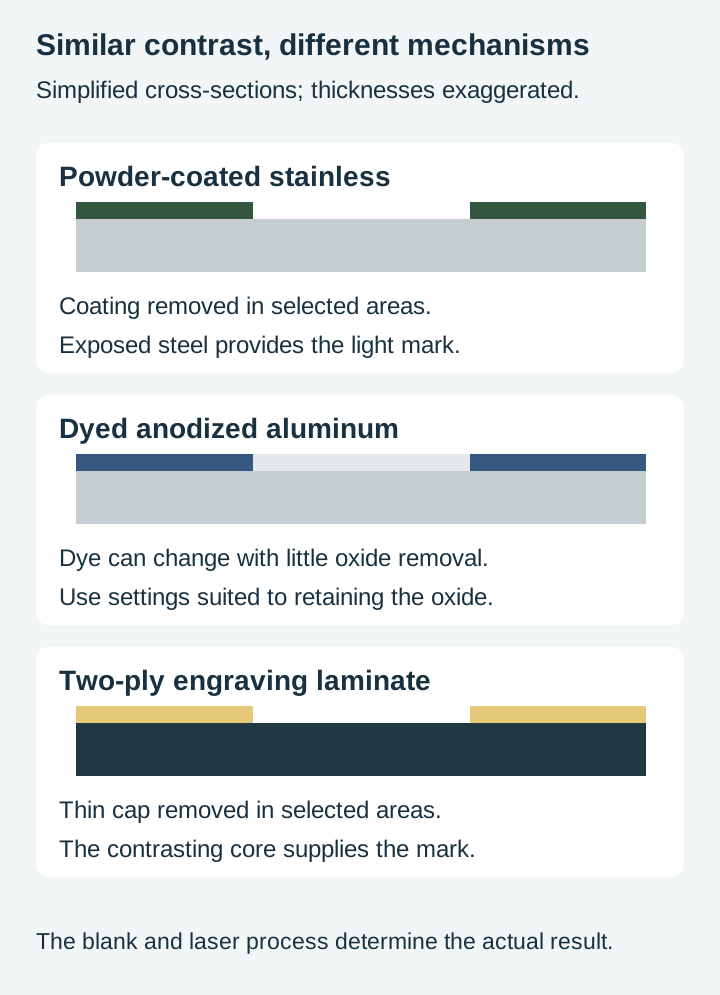
The mark is the absence of a coating
This is the single idea that explains most first-purchase disappointment, and once it clicks the whole category makes sense.
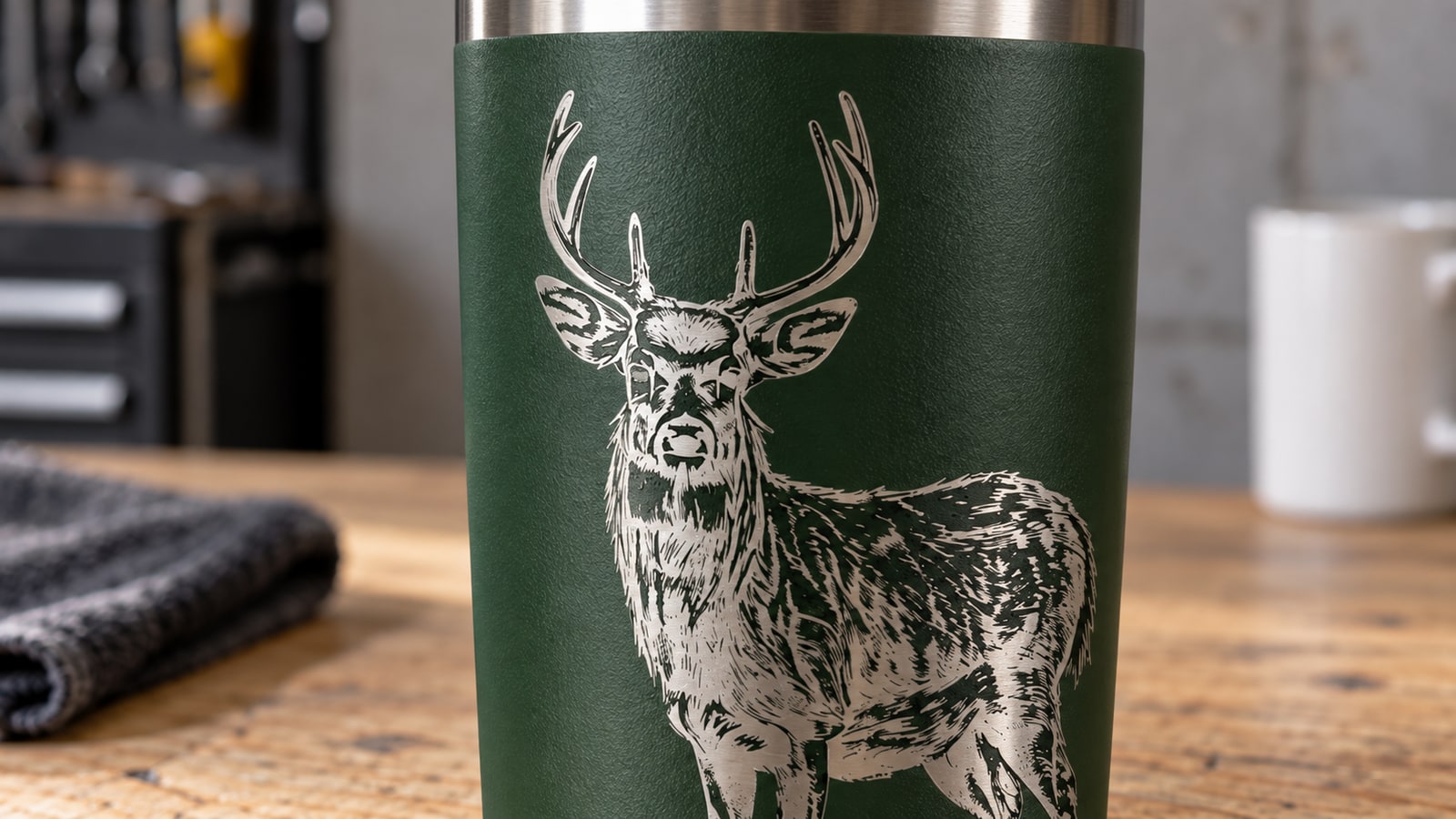
On a powder coated tumbler the laser does not burn a design into steel. It vaporises the coloured coating in the shape of your design, and the bright stainless underneath shows through. Blank suppliers distinguish removal of the powder coating from engraving deeply into the stainless substrate.
That distinction is the whole game. A coated blank is a two-layer sandwich, and your artwork is a stencil deciding where the top layer stops existing.
The same logic runs through a surprising number of the blanks sold to crafters. Two-ply engraving laminate is the most honest example, because the manufacturer sells the effect openly. Rowmark builds its UltraGrave sheets from "a durable UV-stable polymer cap ... laminated over a tough acrylic core," and suppliers who stock it describe the process plainly: the laser removes the top cap layer to expose the contrasting core colour beneath. Other coated stock can work by a similar contrast-layer mechanism, but the beam may also affect the substrate. Check the exact material’s intended laser process.
So the useful question when you are looking at a blank is not "can my laser engrave this material?" It is "is there a layer here for the laser to take off, and what colour is the thing underneath it?"
Powder coated drinkware
Coated drinkware is the biggest personalisation market a hobby laser can serve, and it is popular precisely because the coating does the hard work.
Buy a blank identified for your engraving process and consult its supplier’s starting guidance. Percentage settings do not transfer reliably between different laser systems; test the actual batch with your machine.
Three practical points follow from the mechanism.
Coating colour establishes the starting contrast. Cleanly exposed stainless often reads silver, while heat, residue and settings can alter its appearance. Dark coatings give you the strongest contrast against it, which is why black, navy, and forest green are the colours engravers reach for. A pale grey or white coating produces silver-on-near-silver, which photographs badly no matter how well the job ran.
Every brand's coating is its own material. Powder coat thickness and chemistry vary between suppliers and sometimes between colour runs from the same supplier. Use a spare matching blank for testing. The underside may have different geometry, inserts, coating or focus conditions, so do not assume it represents the sidewall.
Plan for curvature. A rotary can present a broad cylindrical band to the beam. A narrow front design may fit the available focus tolerance without one; a taper still needs appropriate alignment and correction.
Bare stainless is a completely different job
If the tumbler is uncoated steel, none of the above applies, because there is no coating to remove. You are asking the beam to alter the metal itself. Some blue-light diode systems can mark stainless by forming a surface oxide; that is different from removing metal for a deep engraving. xTool’s material-processing guide describes that oxidation route. Fiber and other suitable metal-processing lasers offer different marking and engraving capabilities; there is no universal 50-watt threshold for every job.
Another route is a compatible marking spray, which is essentially a coating you apply yourself. CerMark's LMM-6000 is the best known. The manufacturer's instructions run: shake the can thoroughly, degrease the metal, apply a thin even coat from around 8 to 12 inches, let it air dry for about two minutes, run the laser, then rinse the unfused product off with lukewarm water. The compound bonds into the metal where the beam hits and washes away everywhere else, so once again the design is decided by where a coating survives.
Worth knowing before you order: marking spray is a consumable with a real per-piece cost, and it is a fume-producing step that wants ventilation like any other. Suppliers who sell it also sell to sign shops and awards trade businesses, which tells you the economics suit production runs more than one-off gifts.
Anodised aluminium plays by different rules
Anodised aluminium gets lumped in with powder coat because both give you a light mark on a coloured background, but the physics are not the same, and the difference matters if you care about durability.
For a suitable light-marking process, Trotec describes changing the pigments while removing very little of the anodized layer. That differs from deliberately cutting through the oxide. Settings, alloy, anodizing and laser type affect the outcome.
Anodized aluminum can therefore produce a light mark while retaining much of the protective oxide. Do not assume every laser setting preserves it or every marked part has the same outdoor durability. Trotec contrasts this with mechanical rotary engraving, which cuts through the anodised coating and leaves bare metal exposed to the weather.
For practical purposes it engraves like a coated blank, works on both CO2 and diode machines, and is the friendliest metal a hobby laser will meet. Just do not assume the same is true of the raw aluminium sheet at the hardware store, which is bare metal and behaves accordingly.
Slate: natural, sealed, and coated are three different things
Slate is where this gets genuinely confusing, because the word covers products meant for two incompatible processes.
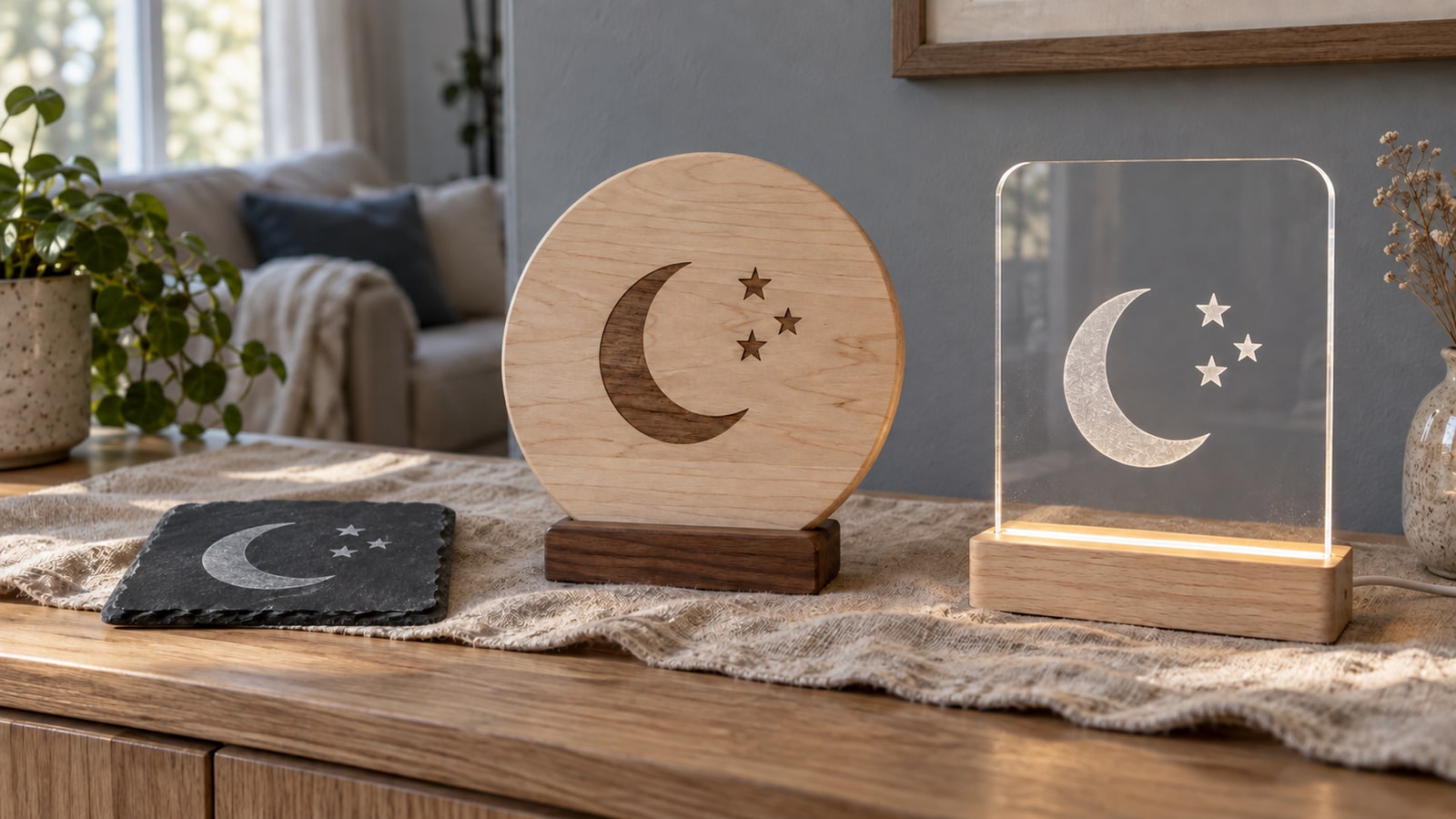
Natural slate is not a coated blank at all. The laser fractures the surface of the stone and the fractured stone scatters light, which reads as a pale grey mark on near-black rock. The stone surface is changed and may lose small particles; it is not simply revealing a contrasting metal layer. That is why slate contrast varies so much between batches: the stone is doing the work, and stone is not manufactured to a spec. JPPlus describe their laser slate coasters as handcrafted real stone with a rough cut natural edge and a sealed surface, and warn that slate "varies from edge to edge since the surface is defined by a natural cleft, having high and low points."
Coated slate is a different purchase entirely. JDS Industries catalogues laserable slate coasters and sublimatable slate coasters in separate sections of its wholesale range, and the sublimation version carries a glossy white polymer coating so dye can bond to it. That coating exists to receive a full-colour printed image under a heat press. Feeding it to a laser is not what it was built for, and a coating you cannot identify is a coating you should not be vaporising in a room you breathe in.
Appearance offers clues, not certification. A white coated face may be intended for sublimation, while dark cleft slate may already carry a sealer. Confirm material and process compatibility with the supplier. Our complete slate engraving guide covers the natural stone workflow in full, and the sublimation blanks guide explains the coated side, where the coating is the thing the process needs rather than the thing it destroys.
 Deer Designs For Slate30 designs, commercial license included$3.99
How to tell what you are buying
None of this requires you to own the blank first. Product listings give it away if you read them for the process rather than the adjectives.
- Look for the process word, not the material word. "Powder coated," "laser engravable," "laserable," "anodised," and "two-ply" are claims about what the item is built to do. "Great for crafting" and "customisable" are not.
- Check which catalogue section it sits in. Trade suppliers separate laserable and sublimatable stock deliberately. A blank listed under sublimation is telling you its surface is a print-receptive coating.
- Ask what colour is underneath. For any coated blank this is the only question that predicts your result. Black coat over stainless gives silver-on-black. A coloured cap over a black acrylic core gives black-on-colour. If the seller cannot answer, they may not know what they are selling.
- Check the specification. Price cannot reliably identify coating chemistry or laser compatibility.
- Buy a couple of spares from every batch. Coating formulations change without announcement, and a representative test on a spare unit is useful before a production run.
The file side: two tones, no middle
Everything above comes from manufacturers and suppliers, because they make the blanks. The next part comes from us, because we draw the files.
For a clean coating-removal design, aim for two reliable local states: intact coating and exposed substrate. Partial removal can leave residue or inconsistent color, so do not assume a grayscale power ramp gives controlled tones.
Photographs and stippled illustrations are still possible. Dithering simulates tones by changing the density of small removed dots while retaining the two local material states. It requires suitable spot size, interval, artwork preparation and testing. LightBurn’s image modes distinguish dithering from power-varying grayscale.
A simpler starting point is artwork drawn as clear filled shapes. Silhouettes, bold monograms, thick-stroke line work, and strong graphic marks all read instantly, because every part of the design is committing to one side of the two-tone divide. This is the same design thinking natural slate demands for a different physical reason, which is why our slate packs suit coated tumblers so well: they were drawn with big filled regions and nothing thinner than a textured surface can hold.
A few design-side habits that carry across every coated blank. These come from how we build the files rather than from anything we measured on a machine, so treat them as a sensible starting point and test on your own blanks.
| Design choice | Why it matters on a coated blank |
|---|---|
| Filled shapes over outlines | An outline-only file removes a thin ring of coating and reads as a faint wireframe |
| Strokes converted to filled paths | Hairlines are the first thing to disappear on a curved or textured surface |
| Bold negative space inside a silhouette | Detail carried by gaps survives better than detail carried by thin marks |
| Prepare continuous tones deliberately | Dithering can simulate shading with dots; direct grayscale needs material testing |
| Check focus across the marked area | Margins do not fix focus error; use suitable workholding or a rotary |
The reverse-contrast question catches people out too. On a dark coated blank, the black areas of your file become the bright silver areas on the finished piece. A design that assumes dark ink on white paper will come out inverted, and fine black outlines on a white background become a spidery pale wireframe rather than the drawing you had in mind. Silhouette-style artwork sidesteps this entirely, since it already reads as one solid subject against one background.
 Bass Designs For Slate27 designs, commercial license included$3.99
 Dog Lover Silhouette Pack32 designs, commercial license included$3.99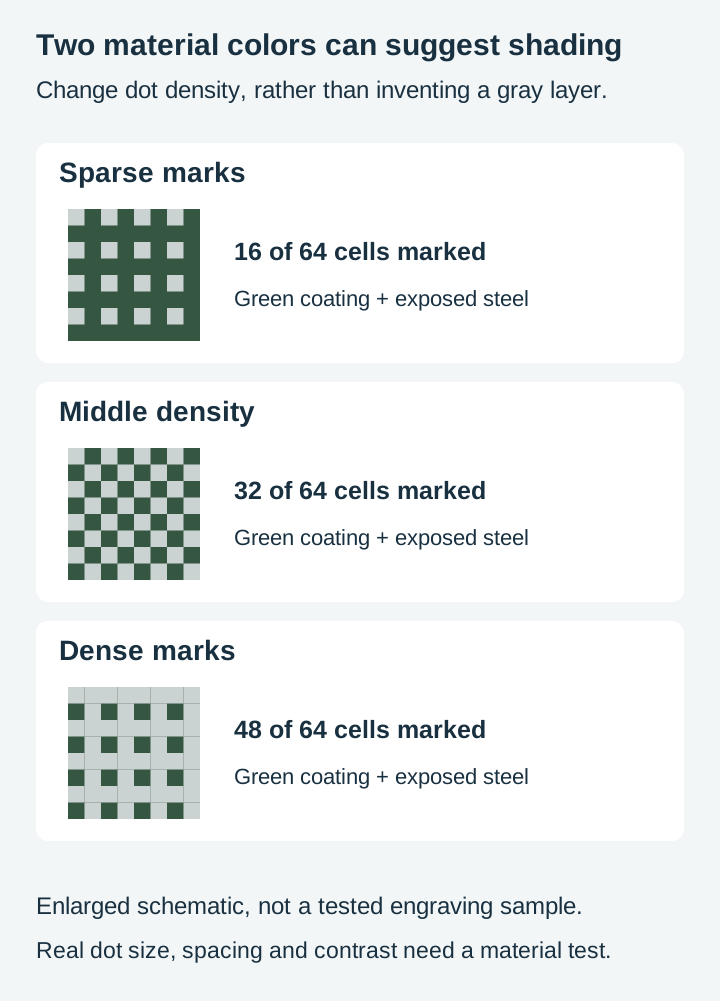
Quick reference
The behaviours below are drawn from the manufacturer and supplier documentation cited throughout this guide. We are a design shop and own no machines, so none of it is measured here, and every blank still deserves a test square before a production run.
| Blank | What the laser does | Result | Notes |
|---|---|---|---|
| Powder coated stainless | Removes the coating | Bright silver on colour | Rotary useful for broad wraps; test focus and coating |
| Bare stainless | Process-dependent surface change or metal removal | Oxide mark or engraving | Some blue diodes mark steel; deeper work needs a suitable metal laser |
| Anodised aluminium | Can alter dye with limited oxide removal | Light mark on color | Coating retention depends on process and settings |
| Natural slate | Fractures the stone surface | Pale grey on dark stone | Not a coating; contrast varies by batch |
| Sublimation coated slate | Not intended for laser | Unpredictable | Confirm the coating’s intended process |
| Two-ply laminate | Removes the cap layer | Core colour shows through | Colour pairing is chosen when you buy the sheet |
| Painted or coated acrylic | Can remove coating and affect substrate | Depends on both layers | Confirm chemistry and intended laser process |
Start with the blank, then pick the file
The habit that saves the most money here is small: decide what is under the coating before you decide what design goes on top. A black tumbler over bright steel and a coloured laminate over a black core are the same job with different palettes, and both want the same kind of artwork.
Every pack we sell ships as SVG, PNG, JPG, PDF, and EPS, so the vector file drives the engraving and the raster versions are there when you need them. Packs are $3.99 each with a commercial license included, no unit cap on the physical products you sell, and new designs are added regularly.
If coated blanks are where you are heading, the slate collection is the natural starting point, since those designs are built from exactly the bold filled shapes that a two-tone surface needs. For the wider picture of what a laser can and cannot touch, the best materials for laser engraving guide covers the full range, including the short list of materials that should never go near a beam.
Designs for this project
Frequently Asked Questions
Why did my tumbler not engrave at all?
Check the blank, wavelength, focus and settings before diagnosing the failure. Coating removal differs from marking bare steel. Some blue diode lasers can mark stainless by oxidation, while deeper metal engraving generally calls for an appropriate metal-processing laser. CO2 workflows often use a compatible marking compound.
Is coated slate the same as the slate sold for laser engraving?
No, and suppliers do not treat them as the same product. JDS Industries catalogues laserable slate coasters and sublimatable slate coasters in separate sections, and the sublimation version carries a glossy white polymer coating so dye can bond to it. Natural slate marks pale grey because the laser fractures the stone itself. A shiny white face may indicate a sublimation coating, but confirm the supplier’s specification.
Do I need a rotary attachment for tumblers?
A rotary is useful for broad designs around a cup. A narrow front mark may work without one if the surface remains within focus tolerance and is held securely. Tapered vessels can require alignment and software correction even with a rotary.
Will a coating-removal mark wash off in the dishwasher?
Suppliers who sell these blanks say no. The Stainless Depot and MakerFlo both describe the result as permanent, on the grounds that nothing was added to the surface: the coating is gone and the exposed steel is the mark. Treat that as the manufacturer's claim rather than a guarantee, and check the care wording for the specific blank you buy.