You engraved a design on acrylic and it barely showed up. Same machine, same settings, same file that produced a crisp frosted white mark last month, and this time the result is a faint glassy scratch you can only see at an angle.
Settings and machine setup do affect engraving contrast, so they are worth checking. But if nothing on your end changed, one possibility is that you bought a different kind of acrylic. Check the supplier’s material identification before changing the design.
Tip
Short answer: with a CO2 laser on ordinary acrylic sheet, cast engraves to the frosted white mark people picture while extruded tends to engrave clear, so contrast-dependent designs nearly vanish on it. Extruded is usually cheaper and more consistent in thickness. Buy cast if the design is engraved, and consider extruded if it is cut through. Diode machines are a different conversation, since many cannot mark clear acrylic directly at all.
Two ways to make a sheet
The names describe manufacturing, which is why the difference is not obvious from looking at the material.
Cast acrylic is made by polymerising the material in place, poured between moulds and allowed to set. The resulting sheet has a higher molecular weight, and suppliers describe it as homogeneous, with much the same mechanical properties in both directions across the sheet.
Extruded acrylic is pushed through a die as a continuous sheet, in much the same way a lot of plastic products are made. The process is faster and cheaper, and it produces a sheet with very consistent thickness.
Everything else follows from those two descriptions, and manufacturers publish guidance on the consequences for their own products. That guidance is the right source for anything about processing, since we make design files and own no machines.
The difference you will actually notice
Engraving, and it is dramatic.
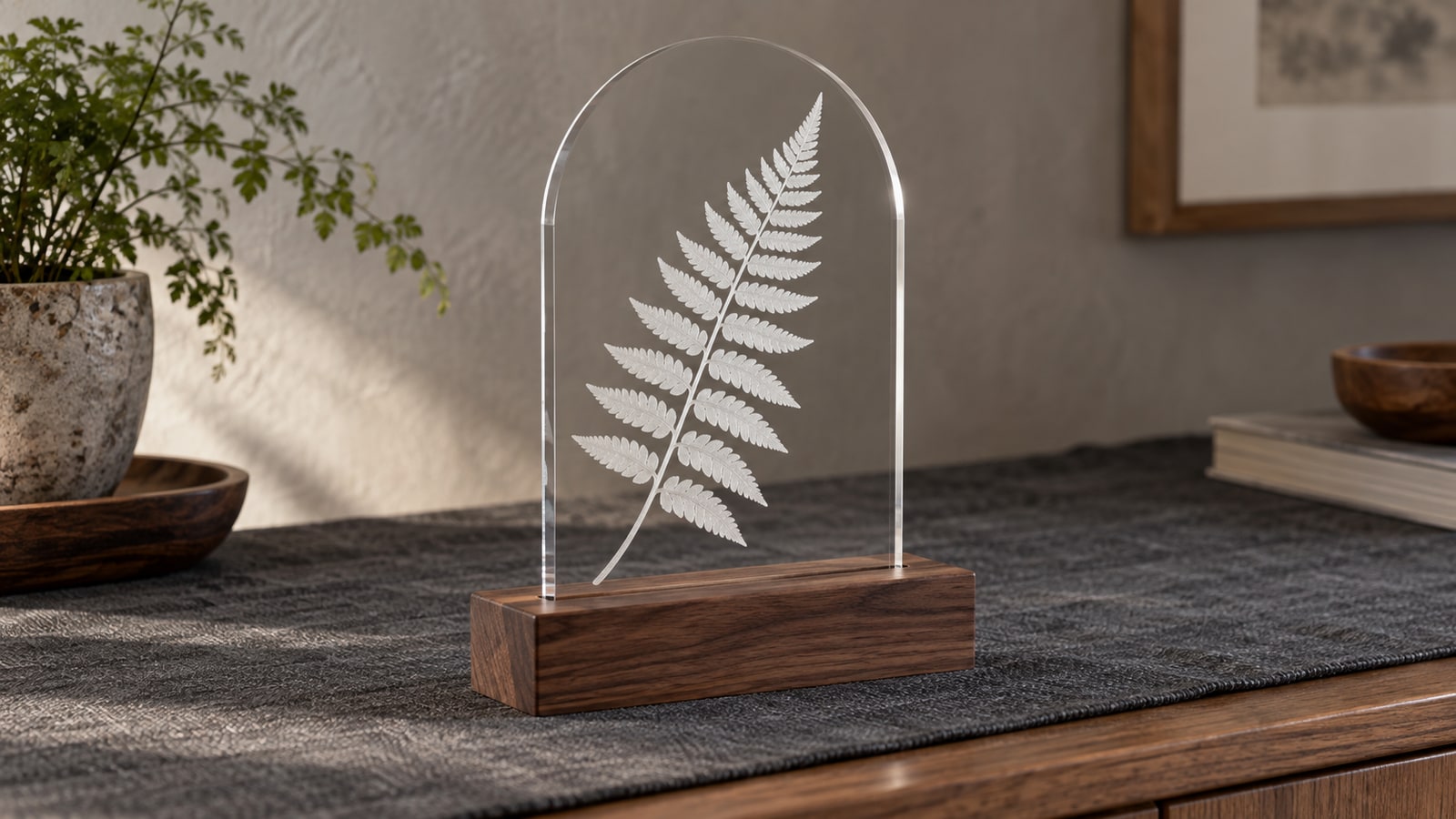
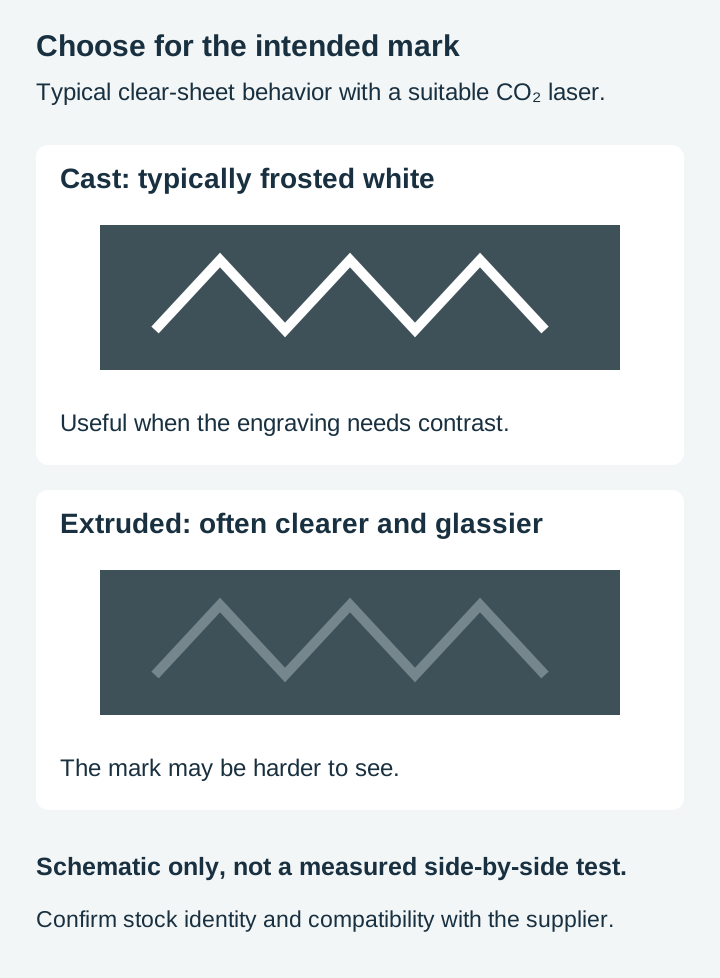
Cast engraves frosted. Manufacturer guidance consistently associates cast acrylic with the opaque white mark most people have in mind when they think of engraved acrylic. That frosting is what gives an engraved design contrast against a clear sheet, and it is why cast is the usual recommendation for engraved work.
Extruded tends to engrave clear. The mark is there, but it stays glassy rather than turning white, so a design has far less contrast and can be genuinely hard to see on a clear sheet.
That single difference decides most purchases. If the design's visibility depends on the engraved area reading pale against the material, you want cast. There is no setting that turns extruded into cast.
 Bar And Drink Designs70 designs, commercial license included$3.99
Where extruded earns its place
Worth saying clearly, because the engraving difference makes cast sound universally better and it is not.
It costs less. For volume work, and for anything where the engraving is not the point, that matters.
Its thickness is more consistent. The extrusion process holds tolerance better than casting does. That matters for anything that has to fit: interlocking pieces, slot-together assemblies, jigs, and inlays where the material thickness is part of the design.
It is widely used for cut-through work, where the finished edge and the shape are what you are selling and nothing is engraved at all.
Cast is a useful starting point for white engraved contrast. Either type can be cut when it is compatible with the machine; thickness tolerance, edge quality and price help decide between specific sheets.
What this means for a design
This is our side of it, since it is about what the file is trying to do rather than how the machine is set up.
Designs that need contrast want cast. Anything where the engraved area has to read as a distinct pale shape. Line art, lettering, detailed illustration, anything where the design is the mark rather than the cut.
Designs that are mostly openings can use either. A cut-through panel where light passes through the shapes does not depend on engraving contrast at all, so the cheaper and more dimensionally consistent sheet is a reasonable choice.
Slot-together pieces need measured thickness. Extruded sheet often has tighter thickness tolerances, but measure the actual sheet and test a slot; kerf and the desired fit also matter. A design with tabs and slots sized for three millimetre material behaves badly when the material is sometimes three and sometimes not quite.
Two-tone work needs a decision. Some pieces use engraved frosting as one visual layer and cut openings as another. Those are cast pieces, because half the design is the frosting.
 Game Room & Arcade Signs39 designs, commercial license included$3.99
The comparison
The notes below summarise how the two materials are generally described by suppliers, and the design-side consequences we can speak to. They are a starting point, not measurements from machines we own. Check your supplier's guidance for the specific sheet you buy, including whether it is suitable for your machine at all.
| Cast | Extruded | |
|---|---|---|
| Made by | Polymerised between moulds | Pushed through a die |
| Engraved mark | Frosted, opaque white | Clear, glassy, low contrast |
| Thickness consistency | Less consistent | More consistent |
| Typical cost | Higher | Lower |
| Suits | Engraved designs, contrast work | Cut-through work, parts that must fit |
| Fit-critical work | Measure actual thickness | Measure actual thickness |
Use cleaners and adhesives approved by the sheet manufacturer. Acrylic can develop stress cracks from incompatible chemicals, and a quick test does not establish long-term compatibility.
Buying it
Keep the label. This is the single most useful habit here. Once a sheet is cut into offcuts, cast and extruded are very difficult to tell apart by eye, and the difference only shows up when you engrave something.
Read the listing rather than the name. Perspex and Plexiglas are brand names, not types. Both brands produce both kinds. A listing that does not say which it is has not told you the thing you most need to know.
Watch for coatings and unusual sheet. Mirrored, and some coloured and specialty sheets, behave differently again, and some are not suitable for laser work at all. This is squarely supplier-guidance territory.
Buy a small sheet of each and test. One offcut of each, engraved with the same design at the same settings, hung side by side. That comparison answers more questions than any amount of reading, and you keep the samples.
The protective film
A small practical note that comes up constantly with acrylic.
Sheets arrive with a protective film on both faces. Whether to leave it on depends on what you are doing and on your machine, and the manufacturer's guidance is the answer rather than a general rule. Some films are unsuitable for laser work.
What is worth knowing regardless: the film is doing real work protecting a surface that scratches easily and shows every mark, and peeling it early is how a beautifully cut panel picks up a scuff before it is finished.
Where to start
Look at the sheet you have and find out which type it is. If the label is gone, ask the supplier. After confirming that the stock is suitable for your laser, a small engraving test can reveal its response, but appearance alone does not prove the material’s identity.
Buy for the intended result. If bright white engraving is important, cast is generally the more suitable starting point.
Our acrylic guide covers working the material more broadly, and our ornament materials post covers where acrylic sits against wood and slate for small hanging pieces.
Every design in our catalogue ships as SVG, PNG, JPG, PDF, and EPS for different workflows. Check which artwork regions should be marked or cut, and adapt supports and detail to the selected material. Browse the full catalogue at $3.99 a pack, commercial license included with every purchase.
Designs for this project
Frequently Asked Questions
What is the actual difference between cast and extruded acrylic?
How the sheet is made. Cast acrylic is polymerised in place between moulds, and extruded acrylic is pushed through a die as a continuous sheet. That manufacturing difference changes the material's molecular structure, and the practical consequences are that they engrave very differently and have different thickness tolerances.
Which acrylic engraves white?
Cast. Manufacturer guidance consistently associates cast acrylic with the frosted white engraved mark most people are picturing. Extruded tends to engrave clear or glassy, so a design that relies on contrast can nearly disappear on it.
Is extruded acrylic worse?
No, it is different. It is usually cheaper, its thickness is more consistent, and it is widely used where cutting rather than engraving is the point. If your design is cut-through work, extruded may suit you better and cost less.
How do I tell which one I have?
The protective film or the supplier listing is the reliable answer, so keep the label. If an unlabelled offcut engraves frosty white it is behaving like cast, and if the mark comes out clear and hard to see it is behaving like extruded. Test on a corner before committing a sheet.