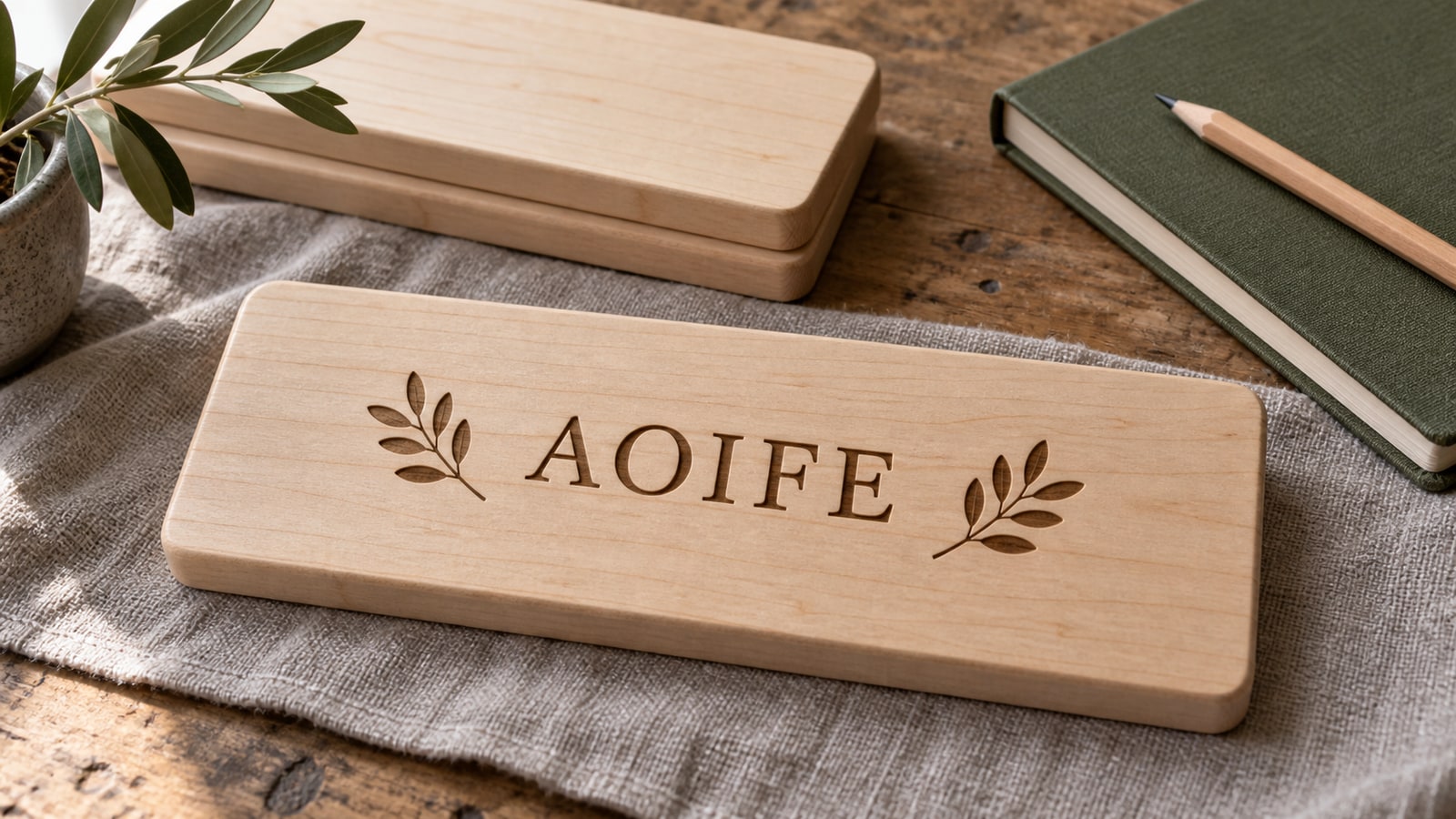
Somebody at the market wants the same sign but with their dog's name on it. Easy, you say. That is a five-minute job.
Three weeks later there have been eleven messages, two design changes, a disagreement about size, and you have cut the piece twice because the name turned out to be spelled Aoife rather than Eefa. The five-minute job has eaten an evening and you charged eight pounds for it.
Tip
Short answer: ask everything up front, get the exact wording in writing, confirm it back before you cut, say how many revisions are included, and set a deadline you can actually hold. The chaos comes from the questions nobody asked at the start.
Custom work is a different product
Worth being blunt about, because it is the root of most of the trouble.
A stock item is made once and sold many times. The design is settled, the setup is done, and an acceptable finished piece can be sold to another buyer if an order changes.
A custom piece is none of those things. It carries a conversation, a setup, a proof, a deadline, and a piece of material that becomes worthless the moment somebody's name goes on it wrong. That is a different amount of work and a different amount of risk, and it should be a different price.
Makers routinely charge stock prices for custom work because it feels like the same object with a name added. It is not, and preparation and correspondence are real costs that belong in the price. Our pricing post covers costing the work properly.
The questions to ask up front
Every one of these prevents a specific problem, and asking them takes about two minutes.
What exactly should it say? Ask for it typed, not spoken. Names are where this goes wrong and it goes wrong permanently.
How big? Confirm actual width and height with units. A familiar comparison, such as a paperback, helps someone picture it but does not replace dimensions.
What material? Keeping the choices few is worth trying as an intake policy. Three is a reasonable place to start, because an open-ended choice turns a decision into research and the order stalls.
When do you need it? Ask early, because this is the answer that decides whether you take the job at all.
What is it for? The most useful question and the one people skip. A retirement gift, a wedding, a memorial, a shop counter. The answer tells you the tone, and it routinely surfaces a constraint the customer did not think to mention.
Where will it live? Indoors or outdoors changes the material and the finish. A sign going on a gate is a different object from the same sign going in a hallway.
Getting the spelling right
The single highest-value habit in this whole process, because it is the mistake you cannot undo.
Ask for it in writing. Typed by the customer, in a message you can go back to. Not written down by you at a stall while somebody says it over background noise.
Read it back separately. Send the exact wording as its own message and ask them to confirm it. Buried at the end of a paragraph about materials, it will be skimmed.
Ask specifically about unusual names. Nobody is offended by being asked to confirm a spelling. Everybody is upset by a permanent object with their child's name wrong on it.
Watch for the things that are not letters. Accents, apostrophes, hyphens, capitalisation in surnames like McDonald or van der Berg, and the difference between a straight and a curly apostrophe. Dates are their own hazard, because date order differs by country and a customer writing 04/07 may mean either of two months.
Keep the confirmation. If a piece comes out matching what the customer wrote, you have a record. That is not about winning an argument; it is about being able to resolve it calmly.
Setting the boundaries
Three things to state when you take the order, in one short message.
How many revisions are included. Two is a common enough figure to be a sensible default, though plenty of makers offer one. Whatever you pick, say what happens beyond it. Almost nobody argues with a limit they were told about at the start, and almost everybody keeps asking when there was never a limit at all.
When the design is locked. There has to be a point after which changes mean starting again, because material has been cut. Say when that is.
What the deadline actually is. Then add margin. Something will go wrong: a bad cut, a material delay, a machine that needs attention. A deadline with no slack in it means the first problem becomes the customer's problem.
For anything with a hard date attached, a wedding or a Christmas gift, set a cut-off well before the date and hold it. Our ornament materials post covers why the seasonal version of this bites hardest.
Proofing without creating work
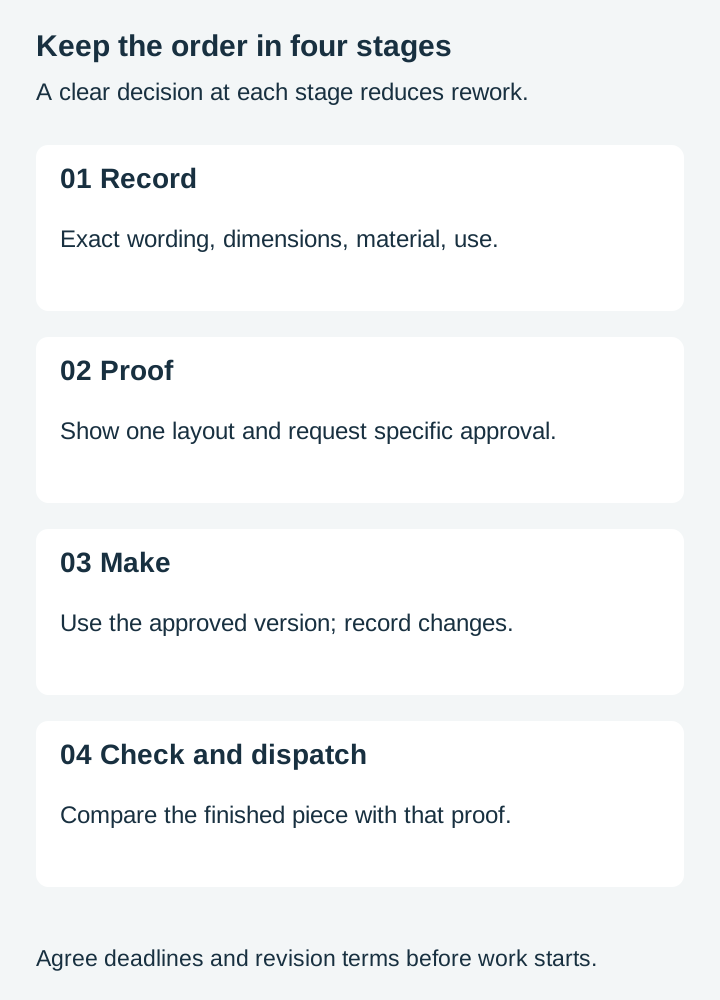
A proof prevents the expensive mistakes and can easily become a project of its own.
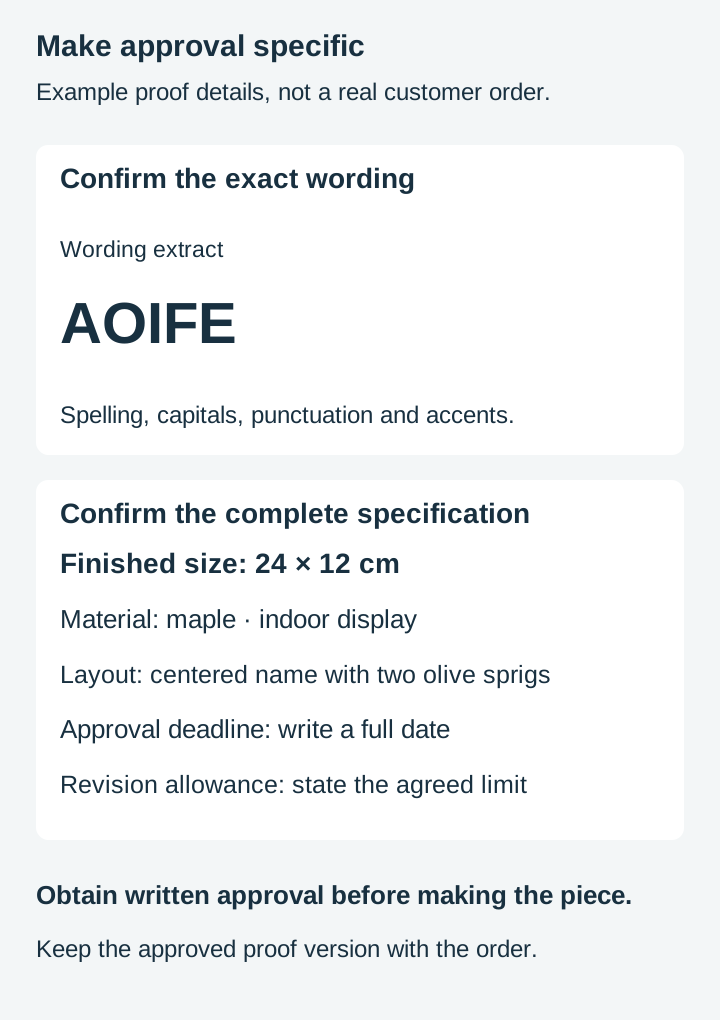
Send one image. A simple mockup showing the wording, the layout, and the proportions. Not three options unless you are charging for design work, because three options invites a fourth.
Say what you want confirmed. Spelling, layout, size. A specific question gets a specific answer; "what do you think" gets a week of nothing.
Give it a deadline. Confirmation needed by a date, or the schedule moves. This is not aggressive, it is the only way a queue works.
Keep approval and completion separate. Obtain approval before making the piece. If you send a finished photograph, describe it as the completed approved design and check it against the agreed proof before dispatch.
Keeping a record
It does not need to be sophisticated. It needs to exist.
A notebook or a spreadsheet with the customer, the exact wording, the size, the material, the price, the deadline, and the date you confirmed. That is enough.
Two reasons. When somebody comes back next year wanting a matching one, you can make the same thing rather than guessing. And when three orders are running at once, the record is what stops you engraving the wrong name on the right piece, which is a genuinely easy thing to do.
When to say no
Worth having thought about before you are asked.
Deadlines you cannot meet. Say so immediately. A disappointed customer today is far better than a failed order next week.
Work outside what you do. A request that needs a technique or material you have not used before is a learning project the customer is paying for and does not know it.
Reproducing a design without permission. Confirm that you or the customer have the rights needed for the intended use. Our licensing post covers what a licence does and does not permit, including ours.
The order that is already going badly. If the questions are contradictory before any work has started, that rarely improves.
Where to start
Write down the six questions from the top of this post and keep them where you take orders. That single change removes most of the chaos, because the chaos is mostly made of things nobody asked at the start.
Then decide your revision limit and your custom price before somebody asks, so you are quoting a policy rather than making one up under pressure.
Every design in our catalogue ships as SVG, PNG, JPG, PDF, and EPS, so one purchase covers the engraved version, the vinyl version, and the sublimated version of whatever a customer eventually asks for. The commercial license is included with every purchase with no cap on how many physical products you sell. Browse the full catalogue at $3.99 a pack.
Frequently Asked Questions
What should I ask before accepting a custom order?
The exact wording, the size, the material, the deadline, and what the piece is for. That last one matters more than it sounds, because it tells you what the customer actually cares about and often reveals a constraint they did not think to mention, like the piece needing to fit a particular shelf or arrive before a wedding.
How do I avoid engraving a misspelled name?
Get the spelling in writing from the customer, then read it back to them in a separate message and ask them to confirm it. A name spoken at a market stall and a name typed by the person who owns it are different levels of reliable, and engraving is permanent.
Should I charge more for custom work?
Almost always. A custom piece carries setup, correspondence, proofing, and the risk that it cannot be resold if something goes wrong. Stock work can still involve setup and service, but usually has less individual proofing. Pricing custom work at stock prices is the most common way makers end up doing more work for less money.
What do I do when a customer keeps changing their mind?
Set the number of revisions when you take the order, and say what happens after that. Most people are entirely reasonable once they know where the line is. The problem is almost never the customer being difficult; it is that nobody said what was included.