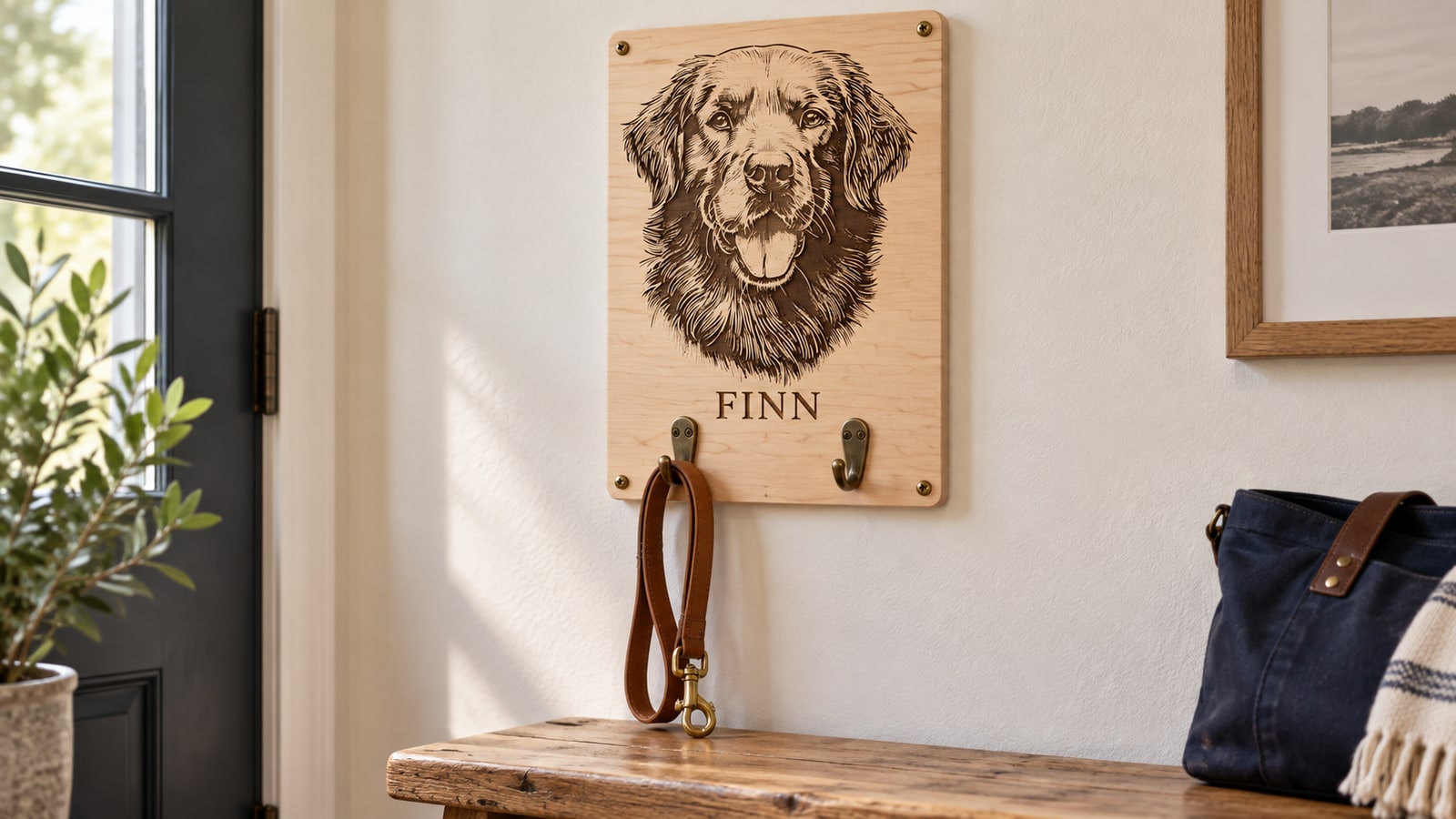
The most common custom request in this whole category is some version of "can you do my dog". The second most common is a correction, sent politely, explaining that what you made is not actually their breed.
Both come from the same place. Dog owners know their breed's outline the way you know a friend's handwriting, and a design that is almost right reads as wrong to them in a way it never will to you.
Tip
Short answer: coat and tail treatment help distinguish the retrievers, alongside their head shape and proportions. The Beagle has a different outline and ear carriage. A Labrador is smooth with a thick otter tail. A Golden Retriever has characteristic feathering along the tail, chest and legs. A Beagle is smaller, squarer, and shorter in the leg, with long low-set ears and a high-carried tail.
The problem nobody warns you about
Our dog breed gift guide covers the commercial side: which breeds to stock, how to personalise, what sells. This post is about the drawing, because that is where breed work actually goes wrong.
Here is the core issue. Reduced to a silhouette, a Labrador and a Golden Retriever are close to the same drawing. The standards do separate them on head, coat, and detail, but at the level of an outline they share a size class, a build, a broad muzzle, and drop ears. If you draw the body and stop there, you have not drawn either breed. You have drawn the shape they share.
Coat is a useful cue that simplistic silhouettes often lose. Also compare head shape, tail structure and overall proportions; removing feathering alone does not turn one breed into another.
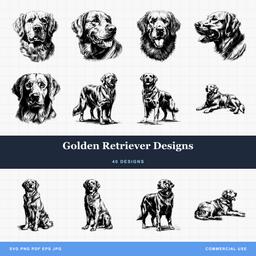 Golden Retriever Designs40 designs, commercial license included$3.99
The AKC Golden Retriever standard, Labrador standard, and Beagle standard provide reference descriptions for these coat, tail and ear cues. Individual pets vary, so a custom portrait should follow the customer’s photographs.
Golden Retriever
The identifying feature is feathering. Longer hair that hangs off the trailing edges: the underside of the tail, the chest, the belly, the back of the front legs, and the back of the thighs. In silhouette this turns an otherwise smooth outline into one with soft fringed edges in specific places.
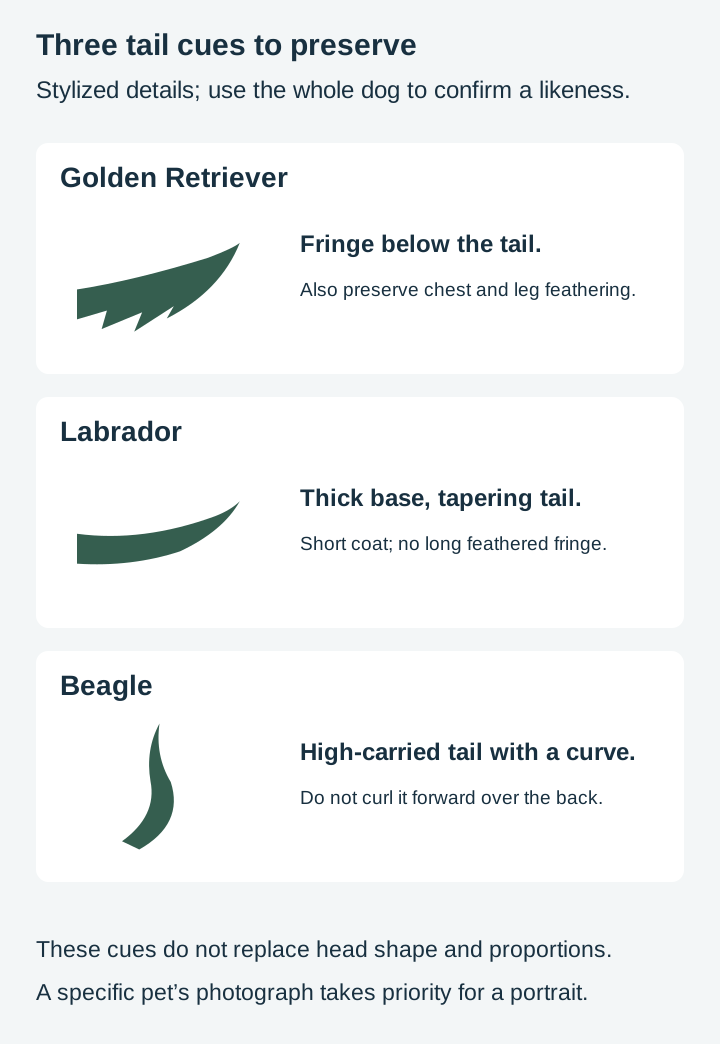
The tail is the single strongest tell. A Golden's tail carries a long fringe underneath that makes it read almost like a plume, and it is usually carried level with the back or slightly above, in a gentle upward curve.
What goes wrong. Feathering is fiddly, so it is the first thing simplified away. The result is a Labrador with a slightly fluffier tail. The fix is to treat feathering as a deliberate shape rather than as texture: draw the fringe as a handful of larger deliberate lobes rather than as many fine hairs. Larger lobes survive cutting, read correctly at a distance, and still say Golden.
Best treatments. Full body profiles where the tail plume is visible. Head studies work but lose the strongest identifier, so if you go head-only, keep the ear feathering.
Labrador
The identifying feature is the otter tail. Thick at the base, tapering, round in cross section, covered in short dense hair with no fringe at all. It is genuinely distinctive and it is the thing to get right.
Everything else about a Labrador is smooth. The outline is a clean unbroken curve from nose to tail, which makes it one of the easier breeds to cut well: fewer coat fringes to preserve. Legs, tail tips and small gaps can still become fragile when reduced.
The colour question. Labradors come in black, yellow, and chocolate, and owners identify strongly with which one they have. A single colour engraving cannot express that. This is the clearest case in the catalogue for either layered vinyl or sublimation, where you can actually deliver the right dog. Our sublimation guide covers the mug and tumbler side.
Best treatments. The widest range of the four. The smooth outline means a Labrador design carries down to small items, decals, engraving, and cutting with fewer compromises than the others here, though your actual floor still depends on the machine, the blade, and the material.
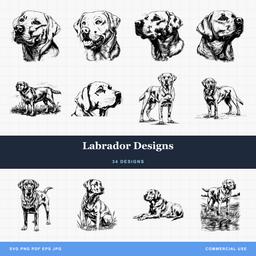 Labrador Designs34 designs, commercial license included$3.99
Beagle
The identifying features are the ears and the tail, working together.
The ears are long, wide, rounded at the tip, and set low on the head, hanging close to the cheek. They are much longer relative to the head than a retriever's ears, and getting that proportion right is most of the breed.
The tail is the opposite of the retrievers: set moderately high and carried gaily upright with a slight curve, and traditionally tipped with white. The breed standard is specific that it should not turn forward over the back, so draw the curve as a cheerful upright rather than a hook. That high tail against a compact square body is instantly readable, even in a small silhouette.
The proportion trap. A Beagle is not a small Labrador. The body is squarer and shorter in the leg, the chest is deep, and the head is proportionally larger. Drawing a retriever at 70 percent scale gets you a mystery dog.
Best treatments. Beagles suit head studies unusually well, because the ears carry the identity even when the body is gone. Good for tags, decals, and small tokens.
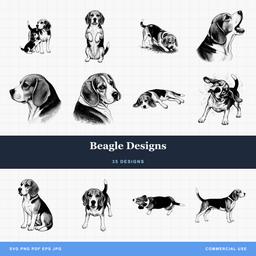 Beagle Designs35 designs, commercial license included$3.99
German Shepherd, since it is always the next question
Worth including because it is consistently among the most requested and because it is a completely different drawing problem from the three above.
The identifying features are the erect pointed ears and the topline. The standard describes high withers running into a level back, followed by a gradually sloping croup, with the rear legs well angulated. The silhouette reads as a long, powerful, slightly rear-lowered outline rather than a continuous downhill ramp.
That distinction is the trap. Exaggerate it into a slope running from shoulder to tail and you get a caricature that owners actively dislike, because the topline is a sore subject among people who care about the breed. Draw the level back, then let the croup fall away.
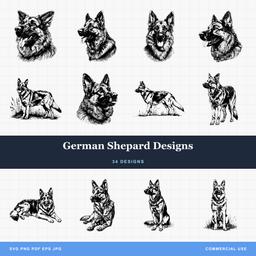 German Shepard Designs34 designs, commercial license included$3.99
What survives at what size
The notes below are a design-side starting point drawn from how we build breed files, not measurements from machines we own. Test on your own material before running a batch.
| Breed | Identifier that must survive | First thing to lose when small | Small-item verdict |
|---|---|---|---|
| Golden Retriever | Tail plume and chest feathering | The fringe, turning it into a Labrador | Keep the tail, drop body feathering |
| Labrador | Thick tapering otter tail | Tail thickness and leg spacing | Test the actual drawing at final size |
| Beagle | Long low ears, upright tail | Ear length, if the head is simplified | Head study reads better than full body |
| German Shepherd | Erect ears, level back and sloping croup | Ear points closing up | Keep ears bold and separated |
The general rule across breeds: whatever makes the breed identifiable is usually the most delicate part of the drawing, which is why breed designs fail small more often than generic dog designs do. Our detail and small items post covers the physical side.
Getting a custom order right
Since most of this work arrives as a request rather than a stock item:
Ask for a side-on photo. Not a cute one. A standing profile against a plain background tells you stance, tail carriage, and coat length in one image, and those are the three things you need.
Confirm the colour variant. Especially for Labradors. Ask before you cut, not after.
Ask whether it is the breed or the dog. Those are different jobs. A breed design is idealised and clean. A specific dog has a bent ear, a scar, a distinctive marking, and the owner will care far more about that detail than about breed accuracy. Our personalisation post covers handling this for customers.
Confirm the name spelling in writing. Engraving is permanent.
Where to start
Stock the breed with the largest local owner base first, then add the ones that are visually distinctive enough to work on small items. In most markets that means a retriever of some kind, then a shepherd, then whatever your area actually walks.
Every pack is $3.99 and ships as SVG, PNG, JPG, PDF, and EPS, so one purchase covers the engraved plaque, the vinyl decal, and the sublimated mug. The commercial license is included with every purchase with no cap on units, and print-on-demand is permitted, which most design sellers do not allow.
Browse the dogs collection for the rest of the breeds.
Designs for this project
Frequently Asked Questions
How do you tell a Golden Retriever from a Labrador in a silhouette?
The coat. A Labrador is smooth all over, so its outline is a clean unbroken curve with a thick tapering otter tail. A Golden Retriever has feathering, which means fringed edges along the tail, chest, belly, and back of the legs. Losing those cues can make the drawing less recognizably Golden, but head and body proportions still matter.
Which dog breed designs sell best?
Breeds with large owner bases reach the most buyers, so the popular retrievers and shepherds are a sensible place to start, and registration figures published by kennel clubs are a reasonable proxy for where the owners are. Distinctive outlines help too, since a breed that is recognisable in silhouette works on small items where a generic dog shape would not. Check what your own market actually walks before you stock deeply.
Does coat colour matter if I am engraving in one colour?
Less than owners think, and more than you would expect. Engraving cannot show that a Labrador is chocolate rather than black, but it can show coat length and texture. For colour-dependent breeds, layered vinyl or sublimation is the honest answer.
Should a breed design be a head study or a full body?
Head studies read better small and suit tags, decals, and keychains. Full body profiles carry the breed identity more reliably, because stance and proportion do as much work as the face. Choose the view that fits the blank and preserves the features the buyer recognizes.