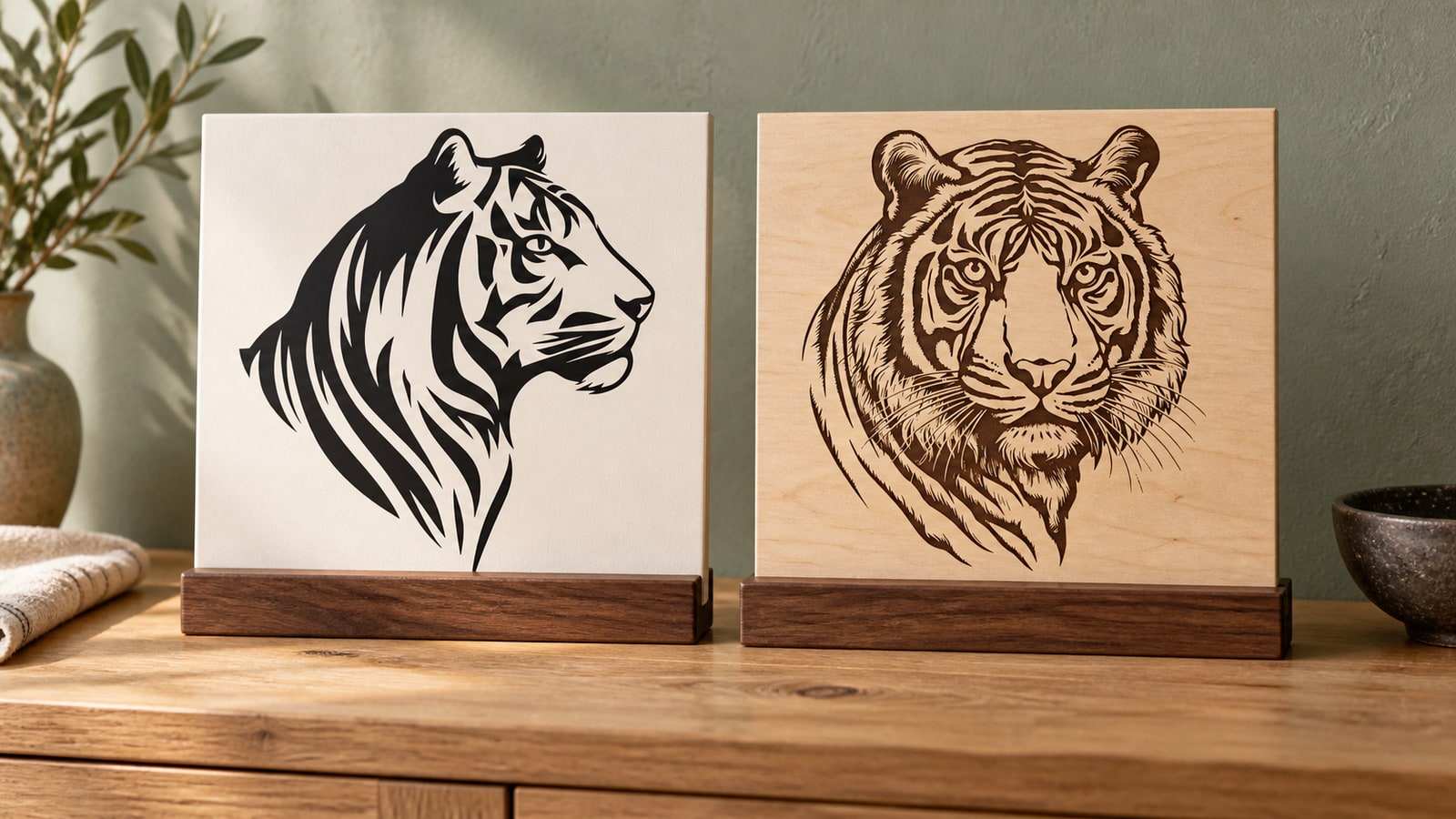
Two files, same animal, wildly different prices of admission. One is a lion built from maybe fifteen clean shapes. The other is a lion carrying two thousand strokes of fur, whisker, and shadow detail. Set side by side on a screen, the detailed one looks obviously better and the simple one looks like the budget option.
Then you cut them both and the picture flips completely, depending entirely on what you cut them into and how big.
Tip
Short answer: these are two different products, not two quality tiers. Low detail is built so a few shapes carry the whole likeness, and it wins on small items, vinyl, single colours, and anything viewed from a distance. High detail is built for tonal range, and it wins on larger engraved pieces where the detail is what the buyer is paying for.
The thing nobody says out loud
A good low detail design is harder to draw than a detailed one.
That sounds backwards, so here is why. When you have unlimited lines available, you can describe a lion by simply recording everything a lion looks like. Fur direction, the shadow under the jaw, the texture of the mane, the catch light in the eye. Accuracy does the work.
When you have fifteen shapes, accuracy is not available. You have to work out which fifteen shapes a human brain needs in order to say "lion" and not "large dog", and then you have to draw those shapes so they balance as a composition on their own. Every one has to earn its place. Delete the wrong one and the whole thing stops reading.
This is why so many cheap "simple" files look wrong in a way people struggle to name. They were made by taking a detailed design and deleting things until it got simple, which produces a detailed design with holes in it. The shapes that remain were never designed to carry the likeness by themselves.
We draw both styles, and the low detail passes take longer. That is the honest version.
What each style is actually optimised for
High detail is optimised for tonal range. It uses line density to create the illusion of light and shadow, the way an engraving or an etching does. It assumes the material stays in one piece and that the viewer is close enough to see the linework. It wants a laser, a decent-sized piece, and a material that takes a clean dark mark.
Low detail is optimised for legibility and structure. It favors broad shapes and useful spacing, but the final size and process still need a test. The design reads instantly from across a room. It works in one colour, which means it works in vinyl, in painted stencils, in single-colour print, and in CNC where you are removing material rather than marking it.
Neither of those is a compromise. They are two different design problems with two different right answers.
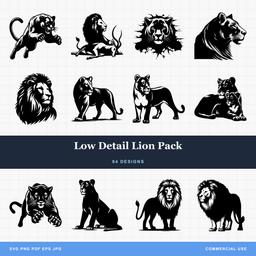 Low Detail Lion Pack84 designs, commercial license included$3.99
Picking by material
This is usually the fastest way to decide, because the material makes the choice for you more often than the size does.
The table below is a design-side starting point drawn from how we build these files rather than measurements from machines we own, so treat it as a way to reason about the choice and run a test piece on your own material before committing.
| Material and method | Style that usually wins | Why |
|---|---|---|
| Laser engraved hardwood, with room for detail | Either; detailed art may suit close viewing | Check mark width, spacing and grain response |
| Laser engraved plywood, small items | Low detail | Small marks still depend on veneer quality, settings and spacing |
| Slate engraving | High detail | Pale marks can give useful contrast; texture varies |
| Adhesive vinyl | Low detail | Narrow retained strips and waste gaps need room |
| Heat transfer vinyl | Low detail | Check both weeding and the HTV application instructions |
| CNC routed wood | Low detail | Cutter shape, depth and access limit the achievable geometry |
| Acrylic, cut through | Low detail | You are separating pieces, so structure beats texture |
| Sublimation | Either | Print resolution, transfer and substrate still limit detail |
| Painted stencils | Low detail | Bridges and open areas need to be large enough to paint through |
The pattern is simple once you see it. Anything where you are marking a surface rewards detail. Anything where you are separating material punishes it.
Picking by size
Size is the second filter, and it applies within a material rather than across materials.
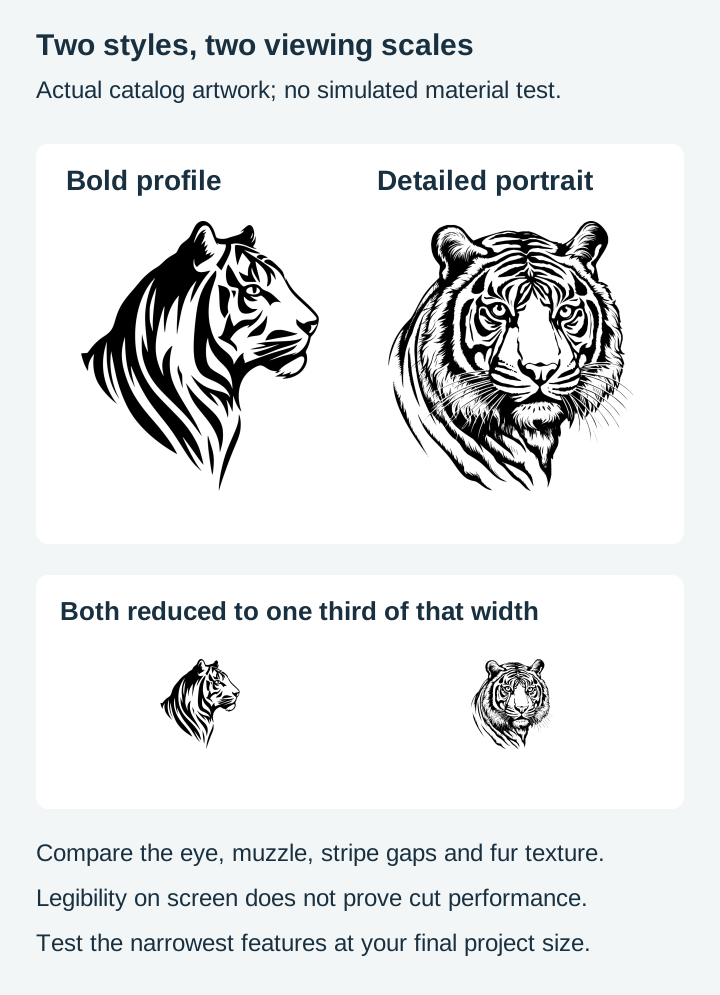
Fine linework has a floor. Below a certain physical size, lines that are meant to read as separate strokes stop being separate: on a laser they run together into a solid tone, on a blade the material between them stops surviving. The design does not gently degrade, it crosses a threshold and turns into a blob.
Where that threshold sits depends on the material, the machine, and how the file was drawn, which is why we will not print a single magic number here. What we can tell you from the drawing side is which designs are near it. A design whose lines are already close together at full size is one that will fail early when you shrink it. A design with generous spacing has more room.
Our post on how much detail survives on small items goes into the physical side of this in more depth.
The practical rule most makers land on: keychains, charms, small tags, and earrings want low detail. Coasters are the crossover zone and depend on the material. Plaques, cutting boards, signs, and wall art can carry the detailed version comfortably.
Picking by buyer
There is a third filter that people forget, and it is the one that affects what you can charge.
High detail sells the craftsmanship. The buyer is paying because the piece is impressive up close. It photographs well in a close crop, it justifies a higher price, and it works as a centrepiece gift. The detail is the product.
Low detail sells the design. The buyer is paying because it looks good and reads clearly. It photographs well from a distance, it works at craft fair price points, and it works on a wider range of blanks so you can build a product line from one file.
That second point matters more than it sounds. One low detail lion becomes a keychain, a tumbler decal, a t-shirt, a stencil, a small sign, and a fridge magnet. One detailed lion becomes an excellent plaque. If you are selling at markets, the design that works on eight blanks is worth more to you than the one that works on one.
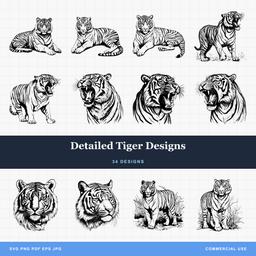 Detailed Tiger Designs34 designs, commercial license included$3.99
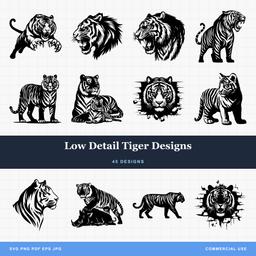 Low Detail Tiger Designs45 designs, commercial license included$3.99
The case for owning both
The situation where this really pays off is a repeat customer or a custom order.
Someone buys a detailed engraved wolf plaque from you and loves it. Three months later they want a matching decal for the back of their truck window. If you only have the detailed file, you are either turning that down, spending an hour simplifying it badly, or cutting something whose thinnest pieces were never going to stay stuck.
If you have both treatments of the same subject, you have a more suitable starting point for the new project. Same animal, same visual family, right file for the job.
This is why a lot of our animal subjects carry both a detailed pack and a low detail pack. Not to sell the same thing twice, but because the same customer genuinely needs both across different projects.
How to tell which one you are looking at
Buying a file from an unfamiliar source, this is how to judge it in a few seconds.
A genuine low detail design has shapes with real width, generous spacing between elements, and a silhouette that reads correctly if you blur your eyes. Every shape looks deliberate.
A detailed design pretending to be simple has shapes that vary wildly in weight, gaps that are much thinner in some places than others, and a few orphaned marks that clearly used to connect to something that got deleted. Squint at it and it turns to mush.
A genuine high detail design has consistent line weight logic, detail that follows the form of the animal rather than sitting on top of it, and no areas of dense texture crammed into a space too small to hold it.
The squint test is the fastest of these. Step back from the screen or defocus your eyes. A well-built design of either style still reads as the animal. A bad one falls apart.
A note on relief designs
There is a third category worth knowing about, because it confuses the comparison. Our relief medallion packs are shaded vector line art. Their drawing suggests sculpted depth, but the supplied artwork does not contain a modeled height surface. Surface engraving or suitable V-carving can use that linework; a modeled CNC relief needs a separately prepared height map or mesh. The relief medallion guide explains the distinction.
Where to start
If you mostly cut vinyl, mostly work small, or mostly sell at markets, start with low detail. It will cut cleaner, weed faster, and fit more products.
If you engrave larger wood or slate pieces and the detail is your selling point, start detailed.
If you do both, which most people end up doing, get both treatments of a subject you already know sells for you. Every pack is $3.99, ships as SVG, PNG, JPG, PDF, and EPS, and includes the commercial license with no cap on physical sales. Print-on-demand is allowed too, which is unusual in this market and matters if you are putting designs on Redbubble or Printful.
Browse the wildlife and big cats categories to see the two styles side by side.
Designs for this project
Frequently Asked Questions
Is a low detail design just a simplified version of a detailed one?
No. They are two separate drawings. A low detail design is built so that a small number of shapes carry the whole likeness, which is a harder drawing problem than it looks. Taking a detailed design and deleting lines from it gives you a worse version of the detailed one, not a good low detail one.
Which style sells better?
They sell to different projects rather than different quality expectations. Low detail wins on small items, vinyl, single-colour work, and anything read at a distance. High detail wins on larger engraved pieces where the detail is the reason someone is paying for it.
At what size should I switch from detailed to low detail?
There is no universal switch size. Check the smallest retained feature and gap at the final dimensions, then test the actual material and process. The same nominal size can suit one drawing and overwhelm another.
Can I use a low detail design on a big sign?
Yes, and it often looks better than the detailed version does. Bold shapes scale up cleanly and read from across a room. The risk is a large flat area looking empty, which a border or a background texture solves.
Do detailed designs cut on a vinyl cutter?
Sometimes, at large sizes, with patience. More often the fine internal detail becomes slivers that tear during weeding. If you are cutting vinyl, start from the low detail version rather than fighting the detailed one.