Small cut files are easy to find. Keychains, coasters, ornaments, gift tags, the whole world of things that fit on a 12 by 12 mat. The wall above a sofa is a different problem, and most cut files fail it badly: scale up a design drawn for a coaster and you get a spindly outline swimming in three feet of empty wood.
Elephants, rhinos and zebras do not have that failure mode. They are heavy, blocky animals with a silhouette you can recognise from across a room, and that is exactly what a large piece needs. This is a genuinely different buyer from the keychain crowd, and it changes which designs you pick, how you cut them, and what you can charge.
Tip
The short version: big animals work at big sizes because they read as a shape, not as detail. Elephants and rhinos are the safest cut-through silhouettes. Zebras are the interesting one, because the stripes are holes in the file rather than marks on it, and that decides whether the panel comes off the bed in one piece.
Why mass beats detail on a wall
A design meant for a two inch keychain lives or dies on its outline, because nothing else is visible at that size. We wrote about designing around detail on small items separately. Wall art inverts the problem. You now have plenty of room for detail, and the risk is that the piece looks fussy up close and invisible from the doorway.
Big African animals solve that by having real visual weight. An elephant is a solid body, a trunk curve and two ear masses. A rhino is a wedge with a horn on the front. Neither needs interior linework to be identifiable, which means you can cut them clean through a panel and let the wall behind become the negative space. That is a look you cannot pull off with a design that only exists as fine hatching.
Scale changes what fine linework does, too. Enlarge a detailed portrait to 30 inches and the strokes that read as texture at 6 inches become individual lines with visible gaps between them. Bold first, detail second, is the safer order for anything going above furniture.
Elephants: the reliable statement piece
The elephant is the most forgiving of the three. The classic side-on standing pose gives you a long horizontal composition, which suits the space above a sofa or a headboard better than anything square. Head-on poses with the ears spread are the other strong option, and those want a taller, more centred wall.
What makes elephants work as cut-through art is that the body is one continuous mass. There is no point where the design narrows to something fragile. Even the trunk, which looks like the weak spot, is usually drawn thick enough to survive being handled at scale. The tusks are the part worth checking before you cut: on some designs they are drawn as separate slivers that will drop out on their own.
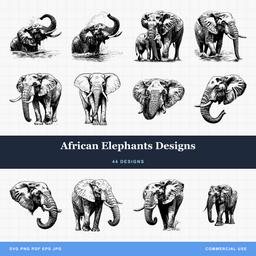
Our African Elephants Designs pack runs across the full range, from heavy silhouettes built for cutting to detailed studies with skin texture and ear veining that are meant to be engraved. Both belong in one pack for a reason: the same buyer often wants a cut-out piece for the wall and an engraved version on a smaller matching board.
 African Elephants Designs44 designs, commercial license included$3.99
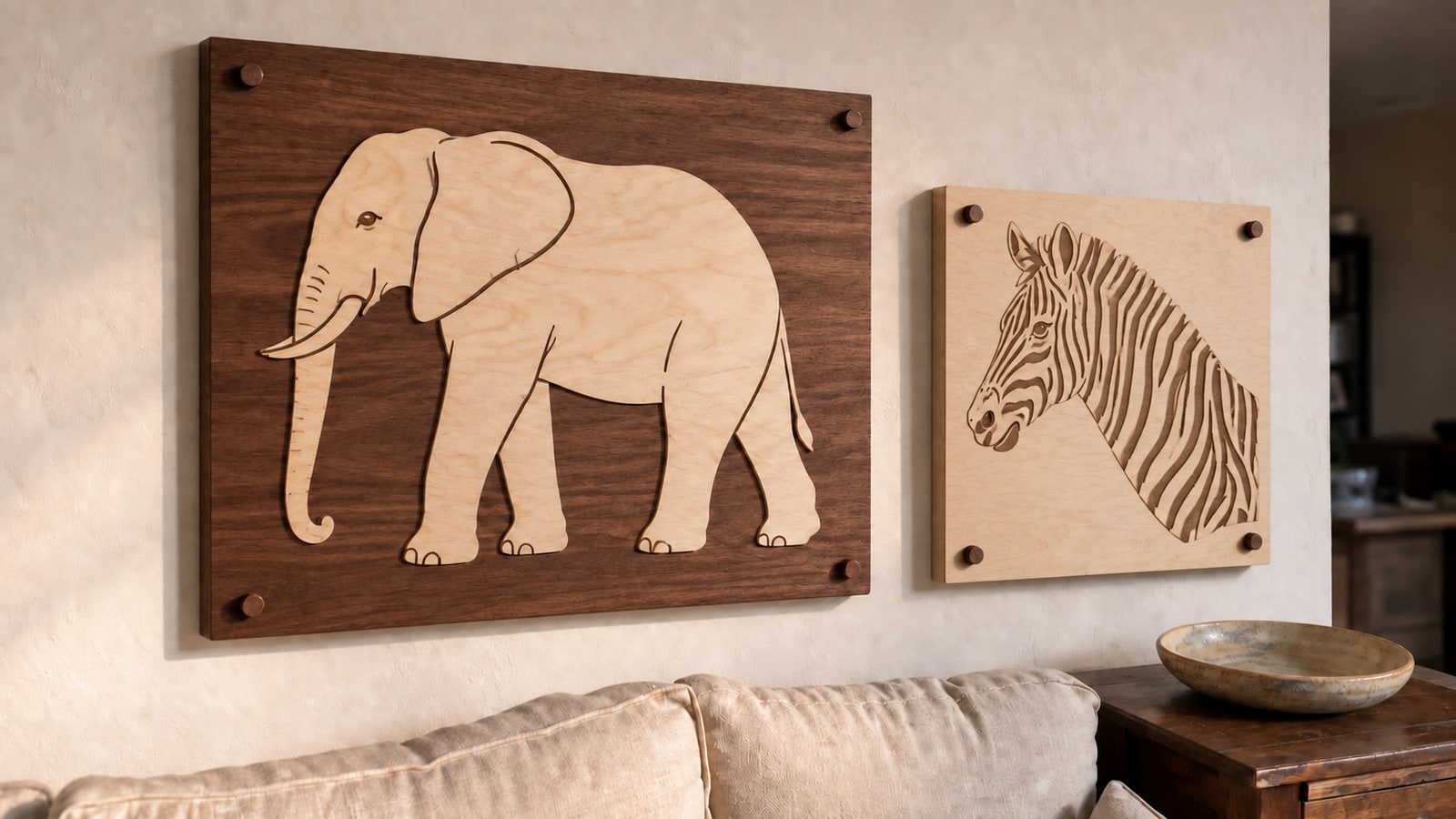
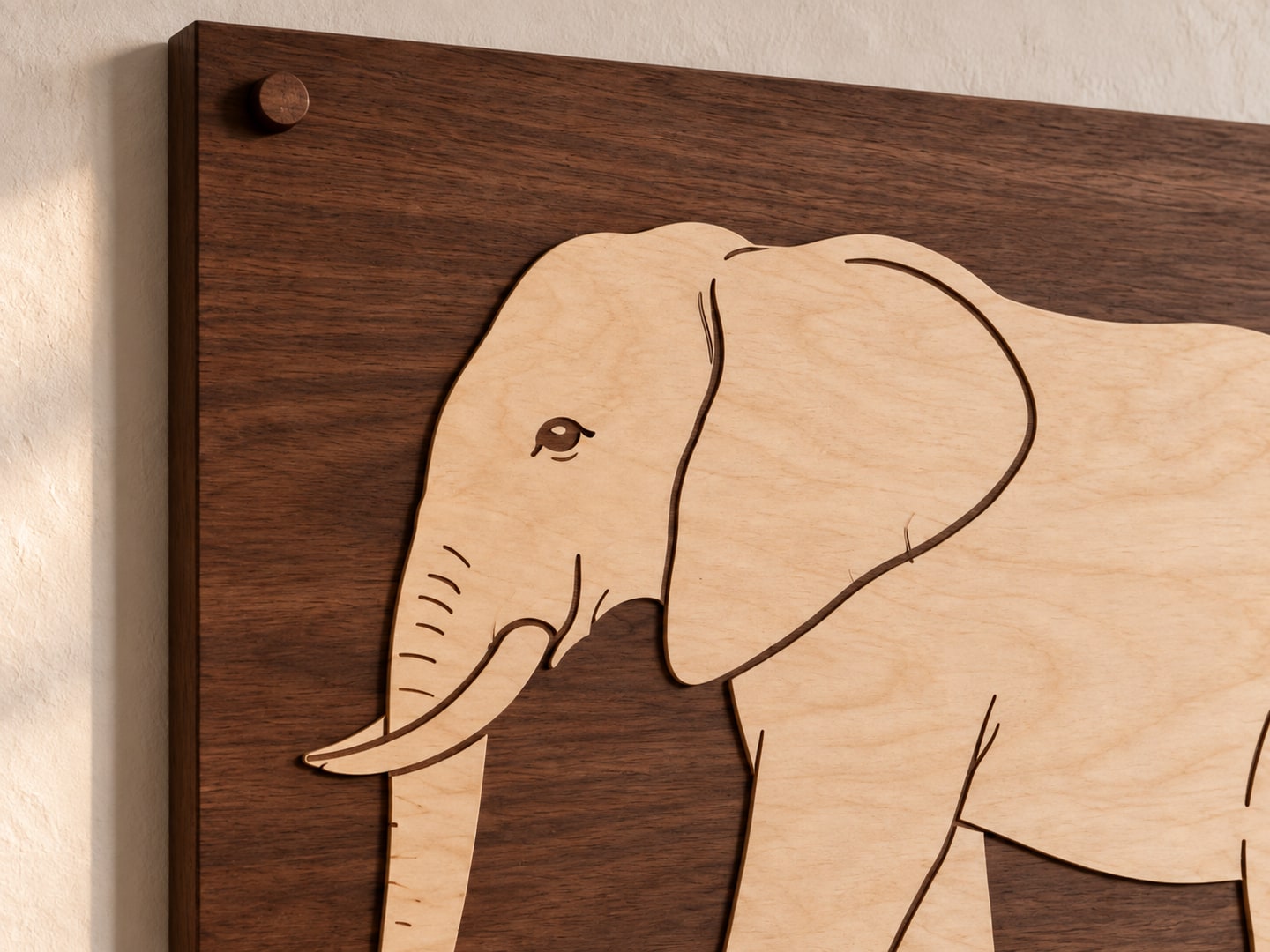
The elephant example below combines a cut outline with engraved detail. The pale elephant is one continuous piece attached to an intact walnut board. Its eye, ear outline and leg lines are marks in the wood, so there are no separate facial pieces to support. A cut-through version would need a different layout that keeps every retained piece connected.
Rhinos: texture that rewards a big panel
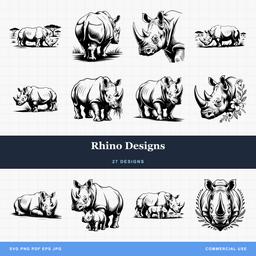
Rhinos are the least used of the three, which is part of the appeal. Unlike the elephant, a rhino has genuine surface interest built into the animal: the plate folds along the shoulder and flank are structural lines rather than decoration, so a design that shows them still reads as a shape and not as pattern.
That makes rhinos the best candidate of the three for a mixed technique piece. Cut the outer silhouette through the panel, then engrave the plate folds and hide texture into the remaining material. The design does the heavy lifting from a distance and pays you back when someone walks up to it.
Dark stock suits rhinos better than pale birch. The animal is visually heavy and a light wood fights that. Walnut, stained oak, or birch stained dark so the freshly cut edge shows as a bright line all work with the subject rather than against it.
 Rhino Designs27 designs, commercial license included$3.99
 Zebra Svg Bundle50 designs, commercial license included$3.99
Zebras: where the file gets interesting
Here is the one that catches people out, and it is worth understanding properly because it applies to every striped or spotted animal you will ever cut.
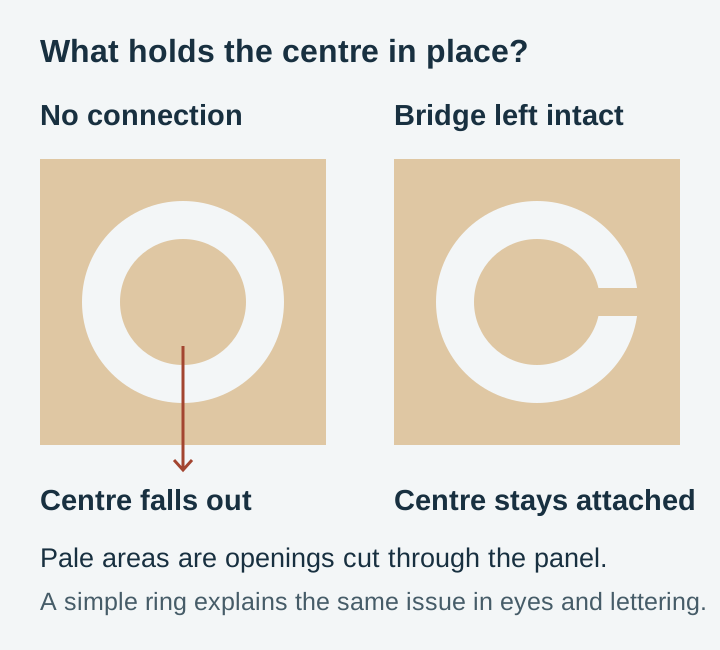
A zebra is not a black shape with white stripes drawn on top. In a well built cut file it is a single compound path: one outer contour for the body, and every stripe is a subpath inside it. The renderer decides which regions get filled by counting how many contours it sits inside, which is why the stripes appear white. They are not white. They are nothing. They are holes in the shape, exactly like the middle of a letter O.
Your machine treats them the same way. Cut that file and every stripe becomes an opening in the panel, which is often exactly what you want: a zebra cut through walnut and mounted on standoffs lets the wall colour show through every stripe. But it means two questions decide whether the piece survives.
Does anything get severed? If a stripe on the belly reaches the outline on one side and a stripe on the back reaches it on the other, and the two nearly meet in the middle, the body is now joined by a narrow neck of material. At 30 inches that neck might be an inch wide and perfectly fine. At 8 inches the same design leaves you a few millimetres, and it will snap when you lift the panel off the bed. Scale is not neutral here.
Does anything float free? Occasionally a stripe pattern encloses a small island of body between two stripes with no connection to the rest. That island is a separate piece and it will drop through the grate. The fix is the same as for a stencil, which is to leave a bridge: a narrow strip of uncut material joining the island to the body, wide enough to survive handling in your material.
There is a quick diagnostic in Inkscape. Select the design and use Path then Break Apart. If it is a proper compound path, every stripe turns into a solid black shape sitting on top of the body and the holes disappear. Undo immediately, because Break Apart destroys the structure that made it cuttable. If nothing changes, the stripes were separate objects all along.
If that sounds like more trouble than it is worth, the escape hatch is to engrave instead of cut. Engraving does not care about compound paths at all: the filled regions burn, the holes do not, and nothing can fall out of a panel you never cut through.
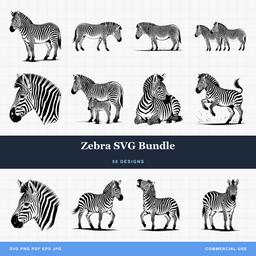
Our Zebra SVG Bundle includes both kinds. Some designs have stripes that stop short of the outline and keep a continuous spine of material, which are the ones to cut. Others run the pattern edge to edge for a graphic look, and those are engraving designs.
Sizing, panels and the bed size problem
Almost nobody has a machine with a 45 inch work area, and that is roughly what a statement piece above a standard sofa wants. Interior decorating advice generally puts wall art at about two thirds the width of the furniture beneath it, which for a 72 inch sofa lands somewhere near 48 inches.
The standard answer is to make it a multi-panel piece. Split the animal across two or three boards, cut each one within your bed size, and mount them with a consistent gap of an inch or two. The gap reads as a deliberate design choice rather than a workaround, and it solves a real problem with large solid wood panels, which is that they move with humidity and a wide one can cup.
The following is a design-side starting point drawn from how the files are built rather than something measured on a machine, so treat it as a place to begin and test on your own material.
| Piece | Rough size | Best approach |
|---|---|---|
| Above a sofa | 40 to 50 in wide | Two or three panel split, cut through, standoff mounted |
| Above a bed | 30 to 40 in wide | Single panel if the bed allows, elephant in profile |
| Entryway or stair wall | 20 to 30 in tall | Head-on elephant or rhino portrait, vertical composition |
| Gallery wall member | 12 to 16 in | Engraved rather than cut, so it holds its own against framed prints |
Scaling up is free from the file's point of view. A vector has no resolution to lose, and our guide to resizing SVG files without losing quality covers the mechanics in each program. The limits are physical: your bed, your material width, and how thin any part of the design becomes at the size you picked.
The CNC option: relief instead of silhouette
Everything above assumes a flat piece. A CNC router opens a different category entirely, which is a carved relief where the animal has actual dimensional depth rather than being a shape cut from a sheet.
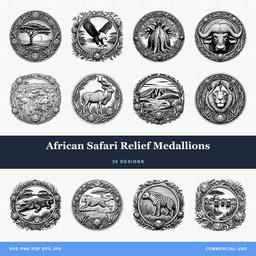
Our African Safari Relief Medallions pack creates a sculpted appearance through vector linework and hatching. It does not contain a depth map or a 3D model. A true dimensional relief carve needs separate height data; what a depth map actually is explains that format before you commit a good piece of walnut to it.
Relief carvings sit at a different price point than cut-out panels, and they photograph beautifully because the raking light does half the work for you.
Finishing so it looks like art
- Standoff mounts. Half inch standoffs lift the panel off the wall and give it a shadow line. It is the single cheapest thing that makes a cut piece look expensive.
- Contrast backing. Mount the cut panel on a painted backer board in a colour that shows through the openings. On a zebra this is transformative, since every stripe becomes a stripe again instead of a hole.
- Seal the edges. Laser cut edges on plywood pick up soot. Wipe them down and seal before mounting, or the first person to touch it gets a grey thumb.
- Match the wood to the animal. Dark stock for rhinos and elephants, and pale birch for zebras where the raw wood plays the part of the white stripe.
Start with one animal
Every pack in the Safari and Exotic collection is $3.99, ships as SVG, PNG, JPG, PDF and EPS, and includes a commercial license, so the wall pieces you sell from it are yours to sell. Pick the elephant if you want the safest first large piece, and come back for the zebra once you have seen how your material behaves at that size.
Designs for this project
Frequently Asked Questions
Why do the stripes fall out of my zebra cut file?
Because each stripe is a hole rather than a shape. A striped animal is normally drawn as one compound path where the body is the outer contour and every stripe is a counter cut inside it, the same way the middle of a letter O is a counter. Cut it and those counters drop out as waste, which is exactly right if you want the wall showing through. It only becomes a problem when two stripes almost meet and leave a thin neck of material between them.
How big should a wall piece above a sofa be?
The usual interior rule of thumb is that art spans roughly two thirds the width of the furniture below it, so a 72 inch sofa wants something in the 45 to 50 inch range. Few hobby machines have a 45 inch bed, which is why big animal pieces are so often cut in two or three sections and mounted with a deliberate gap between them.
Do I need a different file for engraving than for cutting?
Usually not a different file, but often a different design from the same pack. Engraving ignores the whole question of what is a hole and what is a shape, since the fill simply burns. Cutting cares enormously. Detailed designs with fine interior linework are built for engraving, and bolder silhouettes are the ones to cut through.